Skip to content
Menu

A booking made through these earns us a commission from Viator. The price is the same, and the commission had no bearing on what is recommended.

Landmark

Cavalier Heights Visitor Center

Last updated

The park's only real car park, the fee station and the shuttle stop. Set your navigation here, not to the town.

Photo: theinstantmatrixCC0

Closed at the moment

The park is closed on Thanksgiving, 25 December and 1 January.

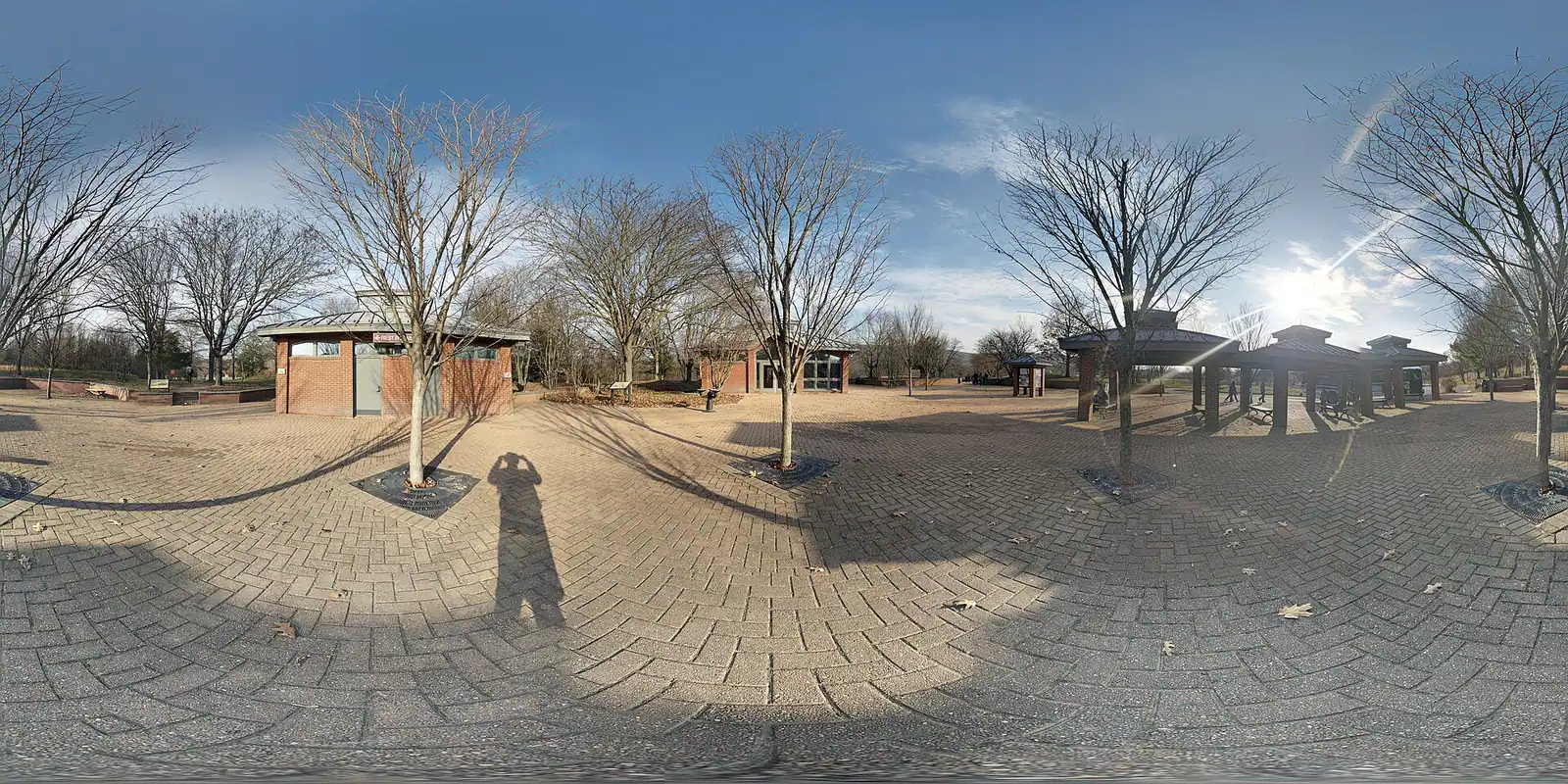
This is the least interesting building in Harpers Ferry and the most important one to get right. The visitor center sits up on Cavalier Heights at 171 Shoreline Drive, directly off US 340, about a mile and a half from the lower town by road and several hundred feet above it. It holds the park's main car park, the fee station, restrooms, an information desk, a bookshop and the stop where the shuttle bus leaves for the bottom of the hill every ten to fifteen minutes.

The reason it exists is that the historic lower town has essentially nowhere to leave a car. What parking exists down there belongs to residents, to deliveries, and to a handful of small private lots that fill early and are not a plan. The National Park Service has spent decades building a system to keep vehicles out, and the system is this building plus the bus.

The trap is satellite navigation, and the park warns about it on its own directions page. Ask a phone for "Harpers Ferry" and it will happily route you into the town itself, or down into the lower town, or to the park's headquarters building, none of which has visitor parking. People discover this at a junction on a narrow street with a queue behind them. Enter the Shoreline Drive address instead and ignore your map's opinion when you reach the turn.

Get here early on a busy day. The lot fills by the middle of the morning on summer and autumn Saturdays, and when it does, the shuttle queue builds behind it. The first bus of the day leaves at nine, and taking it is the single cheapest upgrade available to a visit here: you get the lower town before the coaches arrive.

Three things worth doing inside before you get on the bus. Ask at the desk what is open, because lower-town exhibits close and reopen. Look at the relief map, which explains the terrain better than any view does. And use the restrooms, because the ones in the lower town are busier.
Getting there and parking

Set your navigation to 171 Shoreline Drive rather than to "Harpers Ferry". The entrance is signed off US 340 on Cavalier Heights, west of the river crossings, and the park warns on its own directions page that mapping apps send visitors to the town, to the lower town or to park headquarters instead.

From Frederick, Maryland, it is about twenty miles south-west on US 340. From Dulles it is roughly fifty-five minutes north-west on Route 7 and Route 9. From Charles Town it is about eight miles east.

Once you are in, park, pay at the station or show your pass, and join the shuttle queue. Do not drive on down the hill to look for something closer; there is nothing closer, and the lower town streets are not built for a three-point turn.

The shuttle, precisely

Two stops, one route, and it is impossible to get wrong once you are on it.

Buses run between the visitor center and the lower town every ten to fifteen minutes on every day the park is open. The first departure is at nine in the morning. The last bus back up from the lower town leaves at seven in the evening under daylight saving time and half past five under eastern standard time, which is a genuinely important distinction in November and February when the earlier cutoff catches people out.

Riding is included in the entrance fee. There is no separate ticket and no fare to pay on board.

Practical rules. The buses carry ramps or lifts for wheelchairs and mobility devices. Pushchairs have to be folded before boarding. Pets are not carried, service animals excepted. Coolers and open food and drink are not allowed aboard. Capacity for bicycles is limited, so do not build a towpath ride around putting one on the bus.

If you would rather not take the shuttle at all, the Visitor Center to Lower Town Trail walks down from here. It is a pleasant descent of a mile or so and a real climb on the way back, which is worth remembering at five in the afternoon when your legs have already done Maryland Heights.

Paying, and the fact that there is no cash lane

At the time of writing the park charges $20 per private vehicle, $15 per motorcycle, or $10 per person arriving on foot or by bicycle. Each is valid for three consecutive days. Visitors under 16 are free. A park annual pass is $35 and the America the Beautiful interagency passes are accepted.

The park does not take cash. Not at the entrance station, not at the desk. Bring a card or buy the pass online in advance. This catches out a surprising number of people every week.

Two consequences worth thinking through before you arrive. First, the per-vehicle rate is the cheaper option for a family and the more expensive one for a solo visitor arriving by train, who pays the per-person rate instead. Second, three consecutive days is unusually generous for a site most people see in one, so if you are staying locally the same ticket covers Bolivar Heights and a second morning on the heights.

Fee schedules are revised. Confirm the current figure on the park's website before you travel rather than after you have queued, and check the fee-free days list if your dates are flexible.

What is actually in the building

Modest, and more useful than it looks.

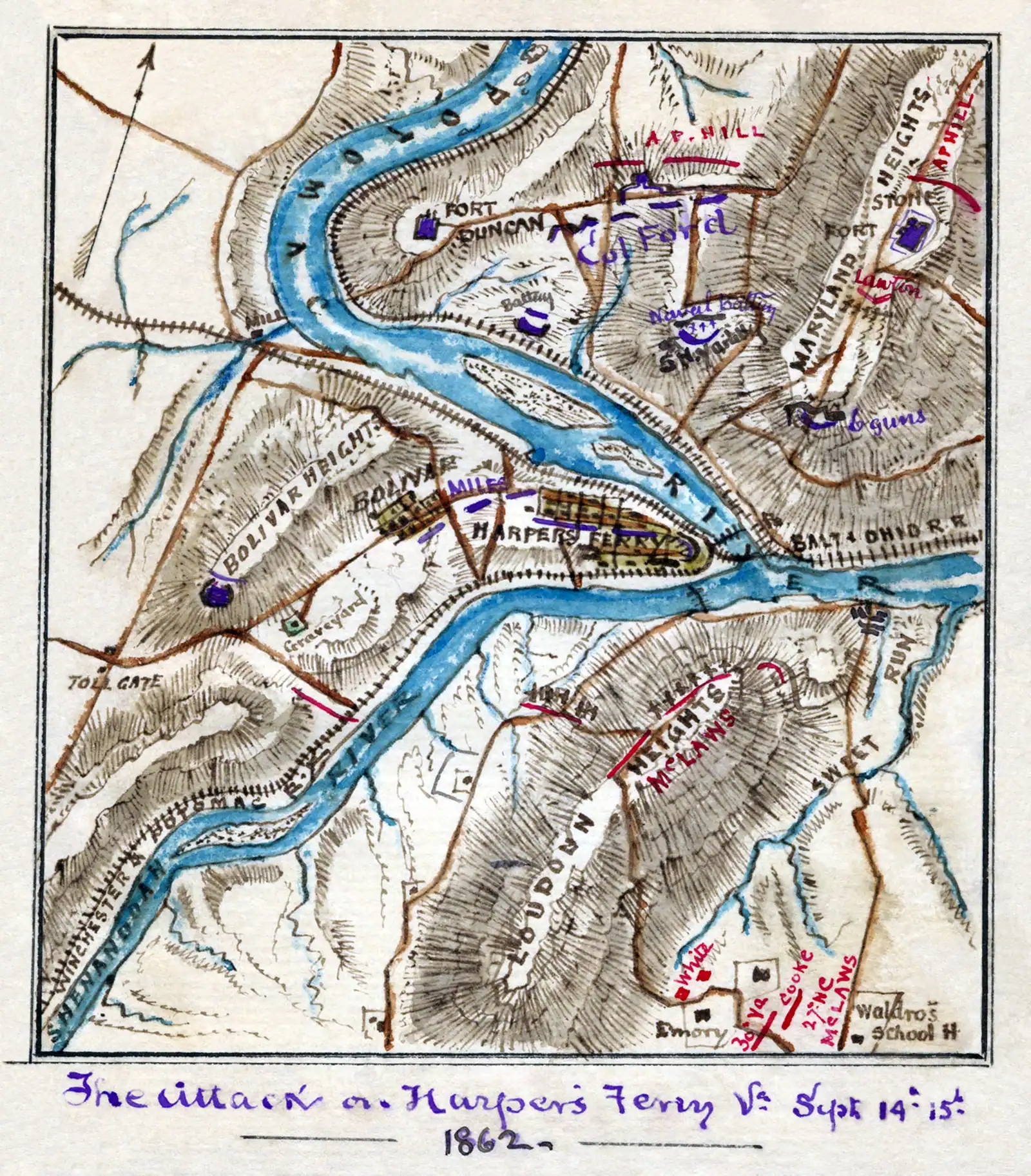
An information desk staffed by rangers who answer the same four questions all day and will still answer yours properly. A bookshop run by the park's cooperating association, which is the best place locally to buy a serious book on the raid rather than a novelty. A short orientation film. A relief model of the gap, which is the exhibit to spend two minutes on, because seeing the three heights and the two rivers in miniature makes everything you do afterwards legible.

Outside there are restrooms, a picnic area near the parking lot, and accessible parking close to the entrance. This is the accessible end of the park: level surfaces, accessible restrooms, and a shuttle designed to carry mobility devices down the hill. The lower town beyond Shenandoah Street is a different proposition.

What is not here is food. There is no restaurant and no café. Eat in Bolivar or the lower town, or bring something for the picnic area.

Ranger programmes, living history and walks are run from both here and the lower town, and the schedule changes seasonally. Ask at the desk on the day rather than planning around a programme you read about online.

When the lot fills, and what to do if it has

The parking area is sized for a park with 400,000 visitors a year, and those visitors are not evenly distributed.

Summer Saturdays fill it by mid-morning. October Saturdays fill it earlier, because peak colour on the ridges and the Civil War anniversaries land in the same three weeks and the town cannot absorb them. When the lot is full, arriving vehicles wait, and the shuttle queue lengthens at the same time.

Three ways round it.

  • Arrive for the nine o'clock first bus. This is the answer most of the time and it costs you nothing but an alarm.
  • Go on a weekday. October midweek is one of the best experiences this park offers and it is a different place from October Saturday.
  • Start somewhere else. Bolivar Heights has its own trailhead parking at the end of Whitman Avenue with portable restrooms and no drinking water. It is flat, open, gives a wide view over the gap, and almost nobody is there. Do that first, then come down to the visitor center when the morning rush has cleared.

Trails and parking lots open thirty minutes before sunrise and close thirty minutes after sunset, which is earlier than the summer evening suggests.

Near Visitor Center

Straight-line distances, so allow more on the road — the island is long and has one main parkway.

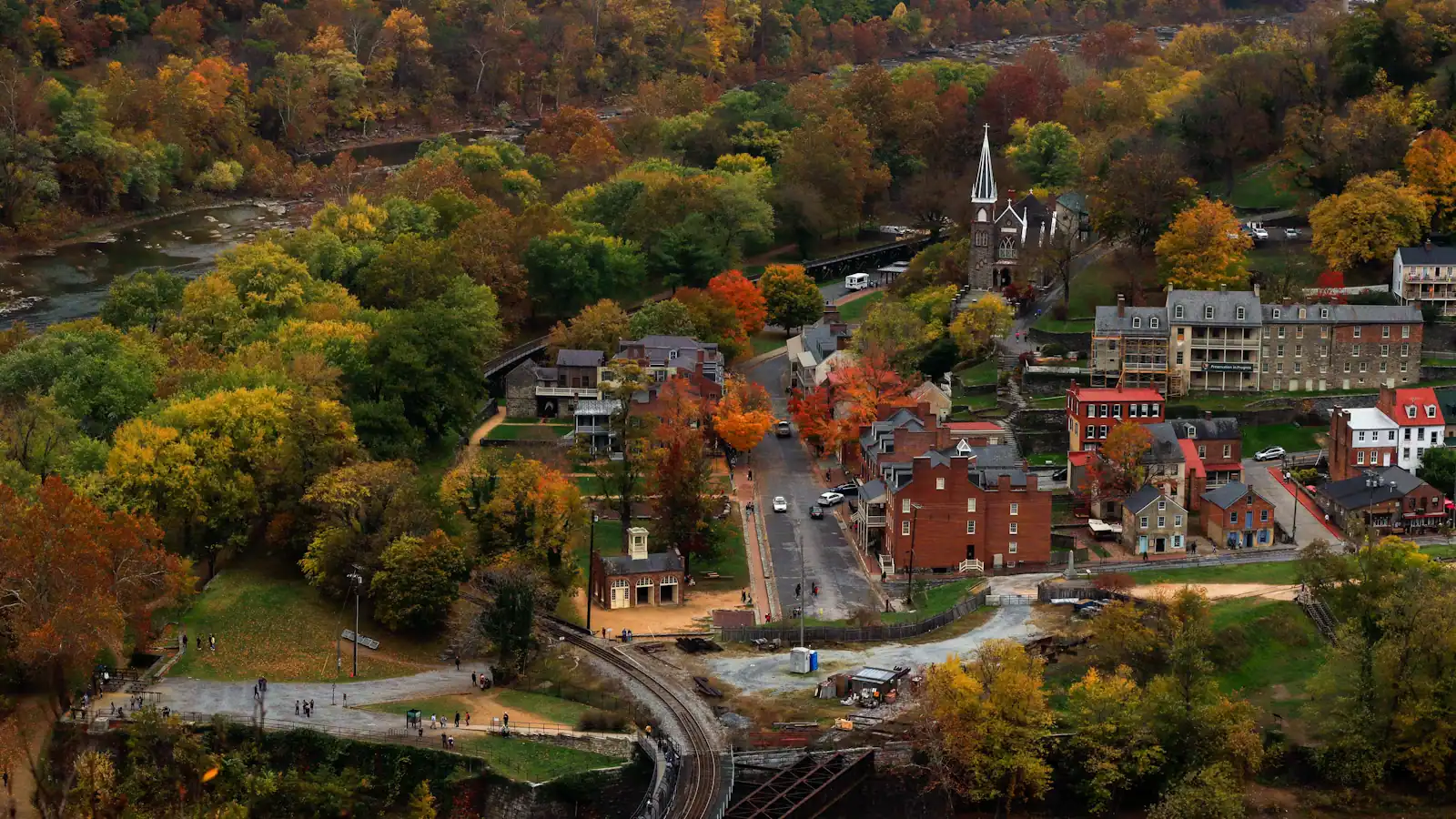
  • A small town of pale rooftops and a church spire seen from above, wrapped by wooded hills and river water

    Park

    Harpers Ferry National Historical Park

    Three thousand acres across three states, with no gate and no loop road — because most of the park is a working town.

    4–10 hoursAround $20 per private vehicle, $15 per motorcycle or $10 per person on foot, valid three consecutive days1.4 mi away

  • A whitewashed stone-walled house on a steep bank, its garden held up by a dry stone retaining wall

    Historic site

    Free

    Bolivar Heights

    Flat, open and five minutes from the car park: the battlefield where a Union garrison of 12,500 surrendered in two days.

    1–1.5 hoursNo separate charge; covered by the park entrance fee, which is valid three consecutive days0.4 mi away

  • A walker carrying a full pack on a trail above a river, trees thick on the far bank

    Neighbourhood

    Free

    Bolivar

    A separate town on the ridge above the lower town, four times the size of Harpers Ferry, where the rooms and the kitchens actually are.

    1–3 hoursFree. Bolivar is a town, not a park site, and carries no entrance fee0.7 mi away

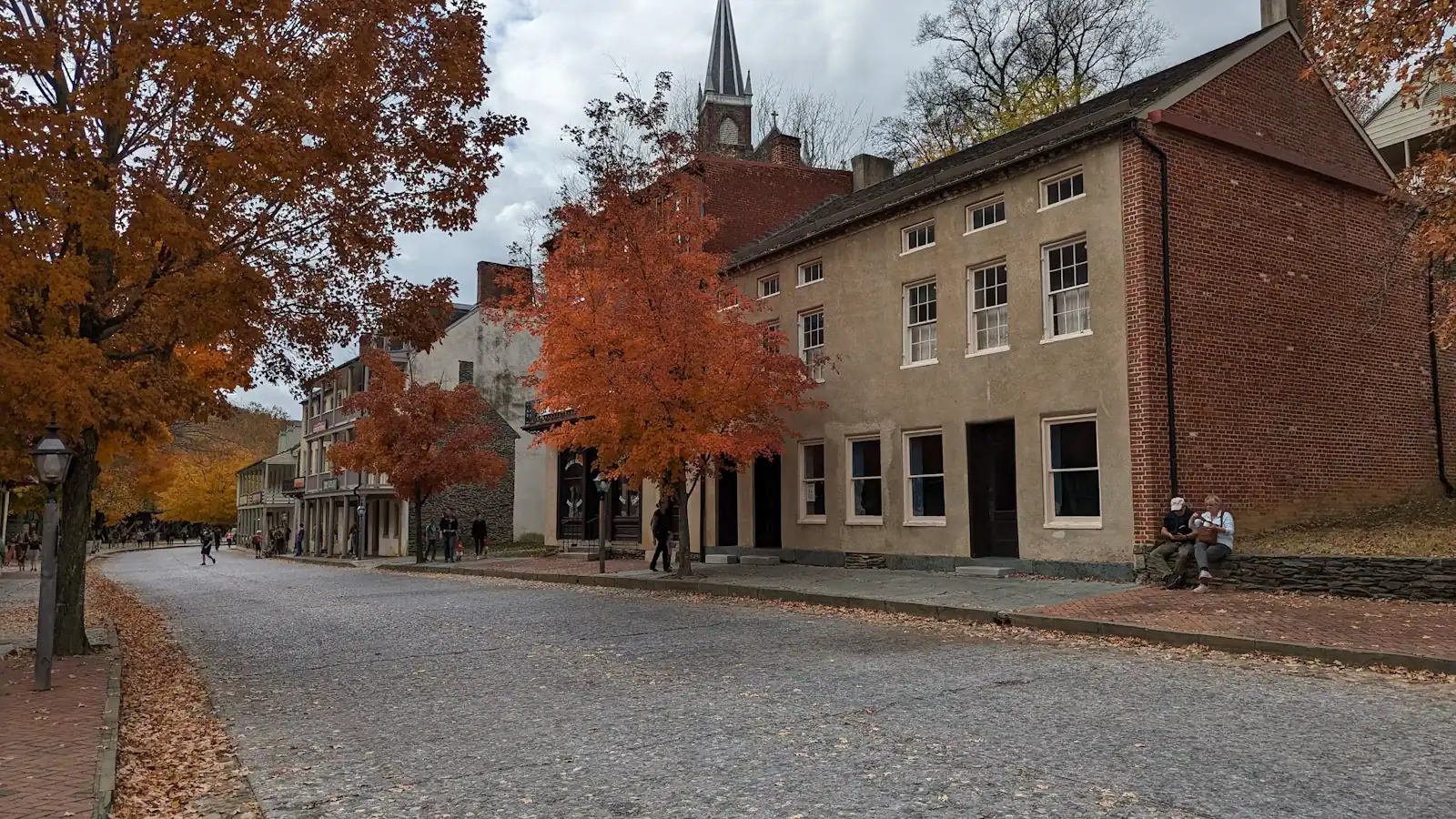
  • A narrow street of nineteenth-century shopfronts running uphill between stone kerbs

    Neighbourhood

    Lower Town Harpers Ferry

    Two streets and a flight of stone steps, all of it inside a national park, with the high-water marks still on the walls.

    2–5 hoursPark entrance fee applies; National Park Service exhibit buildings are then free to enter1.4 mi away

Visitor Center: common questions

Where do you park to visit Harpers Ferry?

At the park visitor center on Cavalier Heights, 171 Shoreline Drive, off US 340. It is the park's main parking area and the only one sized for visitors. From there a shuttle runs down to the lower town every ten to fifteen minutes and the ride is included in your entrance fee. The historic lower town has almost no visitor parking, and driving down to look for a space costs twenty minutes and a difficult turn.

How much does it cost to enter Harpers Ferry National Historical Park?

At the time of writing, $20 per private vehicle, $15 per motorcycle, or $10 per person arriving on foot or by bicycle, each valid for three consecutive days. Visitors under 16 are free, a park annual pass is $35 and the America the Beautiful passes are accepted. The park does not take cash, so bring a card or buy online. Confirm current pricing before you travel; fee schedules get revised.

What time does the Harpers Ferry shuttle run?

Buses leave every ten to fifteen minutes on every day the park is open, with the first departure at nine in the morning. The last return from the lower town is at seven in the evening under daylight saving time and half past five under eastern standard time. That earlier winter cutoff is the one that catches visitors out. Riding is included in the entrance fee and there is no separate ticket.

Why does my sat nav take me to the wrong place in Harpers Ferry?

Because most mapping apps interpret "Harpers Ferry" as the town rather than the park entrance, and some route to the park headquarters building instead. The park warns about this on its own directions page. Neither destination has visitor parking. Enter 171 Shoreline Drive as your destination and follow the signed park entrance off US 340, ignoring any instruction to turn down the hill.

Can you walk down to the lower town instead of taking the shuttle?

Yes. The Visitor Center to Lower Town Trail descends from Cavalier Heights and takes most walkers around twenty-five to thirty-five minutes. It is a pleasant way down and a real climb on the way back, so plan the return honestly, particularly if you have already been up Maryland Heights. Trails open thirty minutes before sunrise and close thirty minutes after sunset, which is earlier than a summer evening suggests.