Skip to content
Menu

A booking made through these earns us a commission from Viator. The price is the same, and the commission had no bearing on what is recommended.

Historic site

St Peter's Catholic Church

Last updated

The spire in every aerial photograph of this town, and the only church here that came through the war standing.

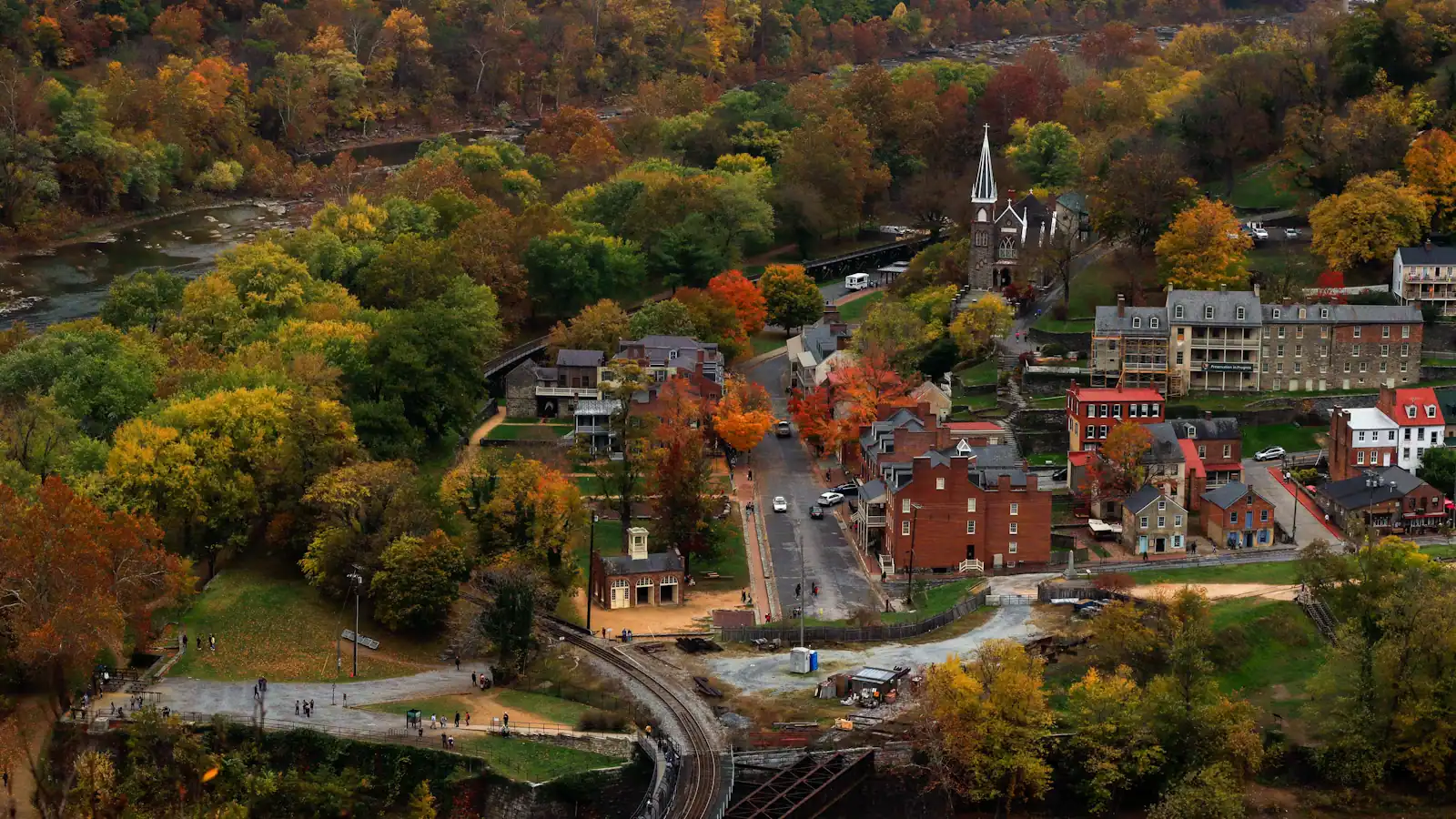
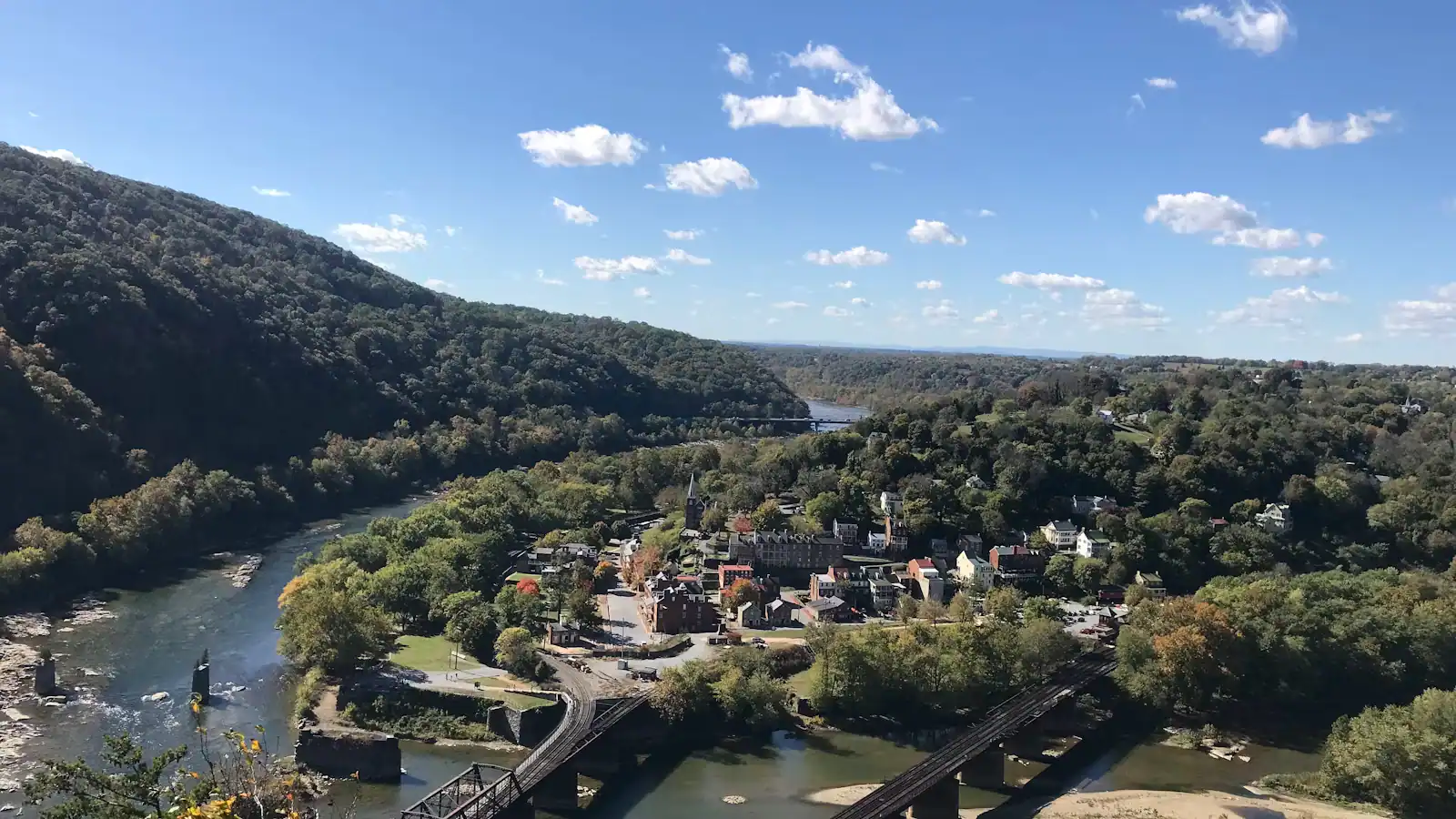
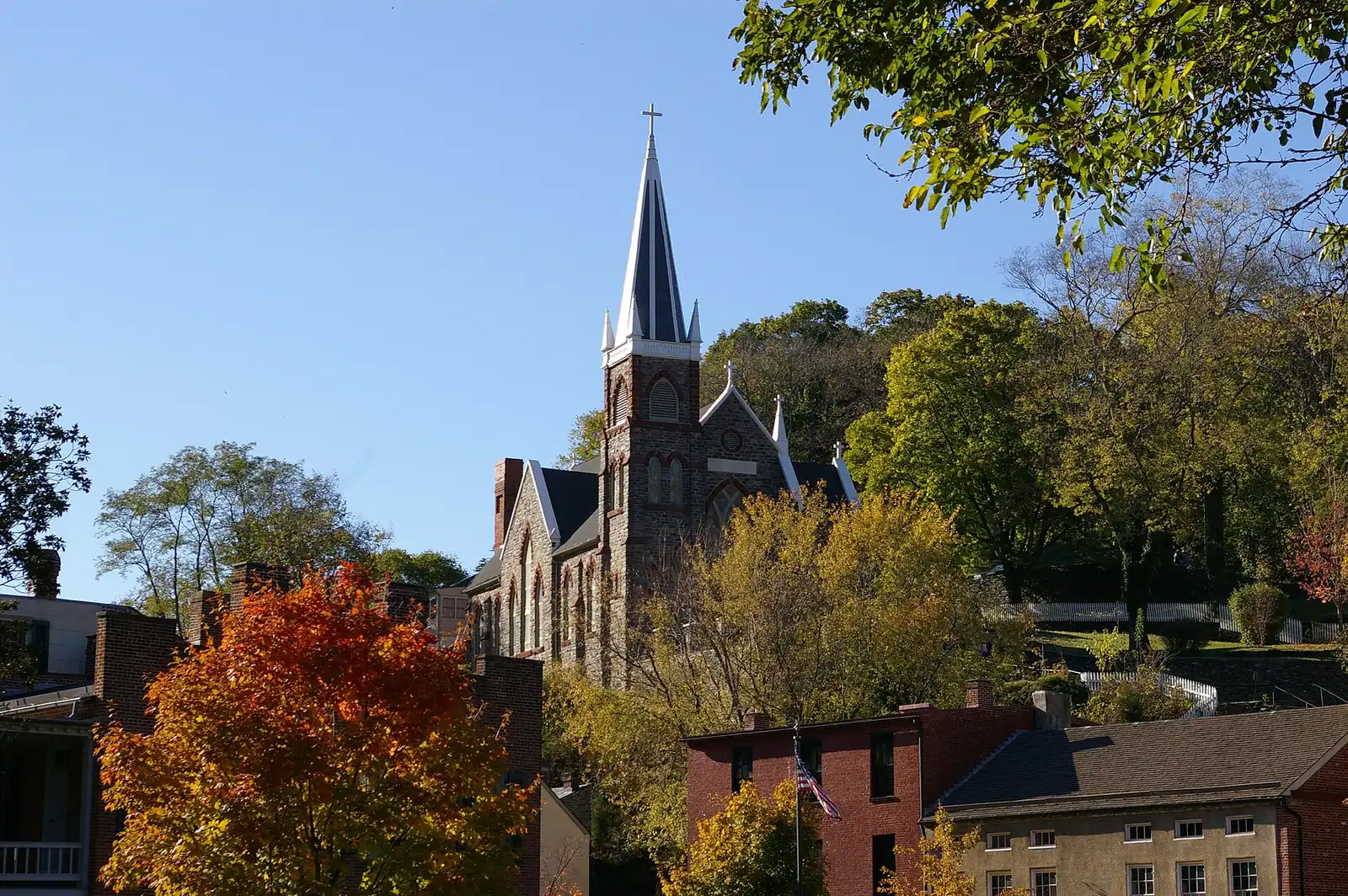
Every picture taken of Harpers Ferry from Maryland Heights has the same vertical accent in it: a grey stone spire standing on the lip of the hillside, apparently about to step off into the Shenandoah. That is St Peter's, and it is on the stone-step route between High Street and Jefferson Rock, so you walk past it whether or not you meant to.

It was built in 1833, in a plain pseudo-Gothic that would not have looked much like what you see now, for a congregation made largely of Irish labourers. Those men were here in numbers because two enormous construction projects were being driven through this gap at once: the Chesapeake & Ohio Canal along the Maryland bank and the Baltimore & Ohio Railroad through the town. Both were built substantially by Irish immigrant labour, and a Catholic church on the hillside was what that workforce needed and paid for.

Then came the war, and the extraordinary fact about this building. Harpers Ferry changed hands repeatedly between 1861 and 1865 and was shelled from all three heights. Every other church in the town was destroyed or wrecked. St Peter's was not. It came through standing, and during the fighting it served as a hospital.

The reason usually given is that the priest flew a British flag over it to claim neutrality. It is a very good story, it is told everywhere here, and historians treat it with some caution. What is certain is that the building survived and its neighbours did not — the roofless shell of St John's Episcopal Church, a two-minute walk further up the same path, is what the alternative looked like.

The church you photograph today is not the 1833 one in appearance. In 1896 the architect Thomas J. Collins recased and remodelled it into the Victorian Gothic building standing now: grey stone with red sandstone trim, lancet windows of coloured rather than figurative glass, and that tall spire. Inside it is a single bright room with a vaulted ceiling. It remains an active mission church of St James in Charles Town.

Getting there and parking

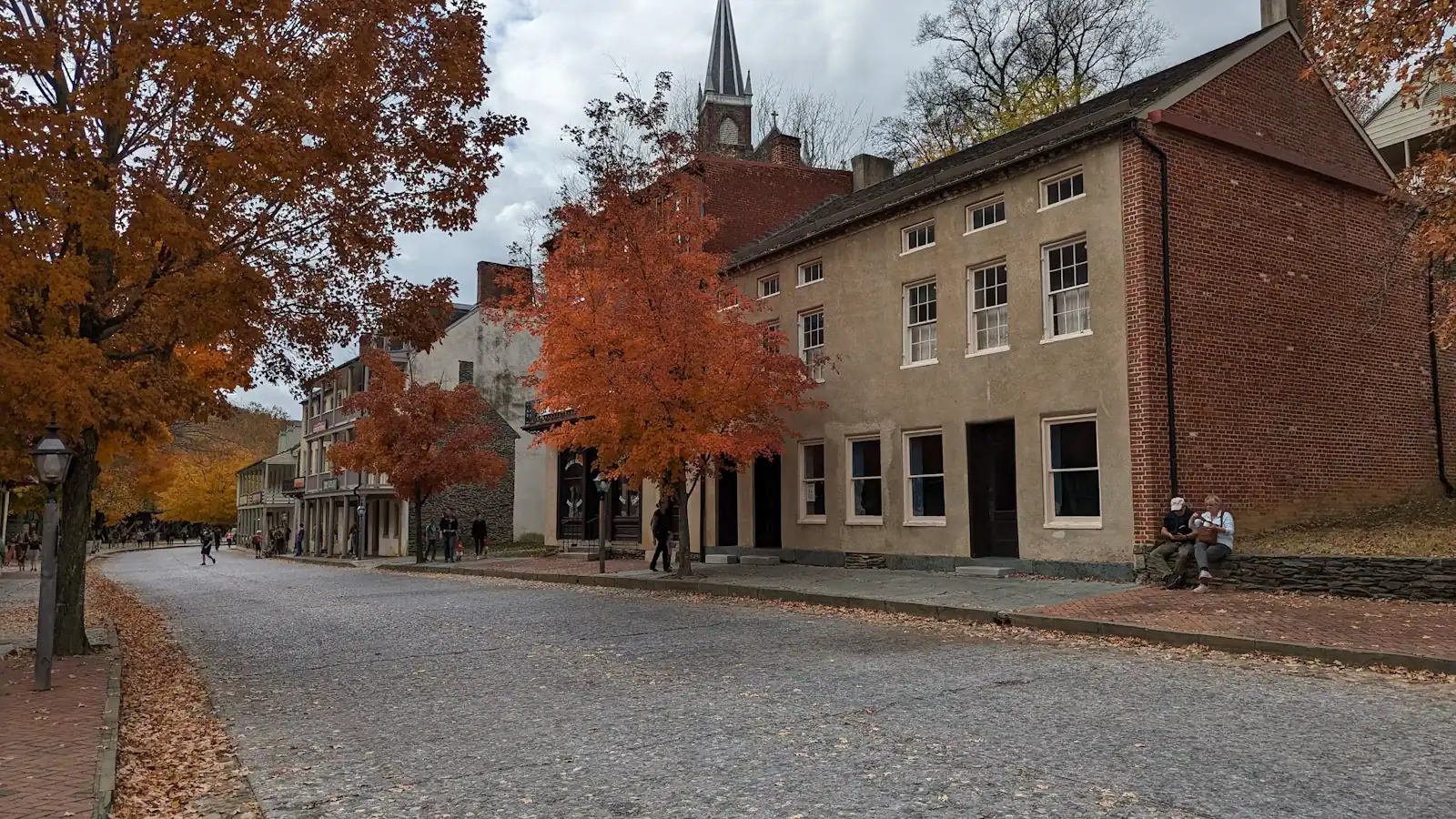
From the shuttle stop, walk along Shenandoah Street, turn up High Street, and take the stone steps at the top of the shopfronts. The church is five or six minutes of climbing from there, directly on the path.

The same route carries the Appalachian Trail, so it is signed and heavily walked.

There is no vehicle access and no level approach from the lower town. A road route through Bolivar reaches Camp Hill above, from which you can come down to the church on the path, but parking up there is residential and limited.

The steps are stone, worn concave and without a continuous handrail, and they are slick with wet leaves in October and ice in January. Coming down is harder than going up.

Where it sits on the climb

St Peter's is the first of three stops on the stone-step route out of the lower town, and treating the climb as a sequence rather than a dash to Jefferson Rock makes it a much better half hour.

Up High Street, then onto the 1810 stone steps at the top. Five or six minutes of climbing.

St Peter's. The path runs directly past the church on its terrace, with the drop to the Shenandoah below. The best exterior angle is from a little above it, looking back and down, with the river behind.

St John's Episcopal. Two minutes further up: walls, window openings, no roof. Wrecked during the war and left as a ruin. It is the quietest spot in the historic district and the direct counter-example to St Peter's survival.

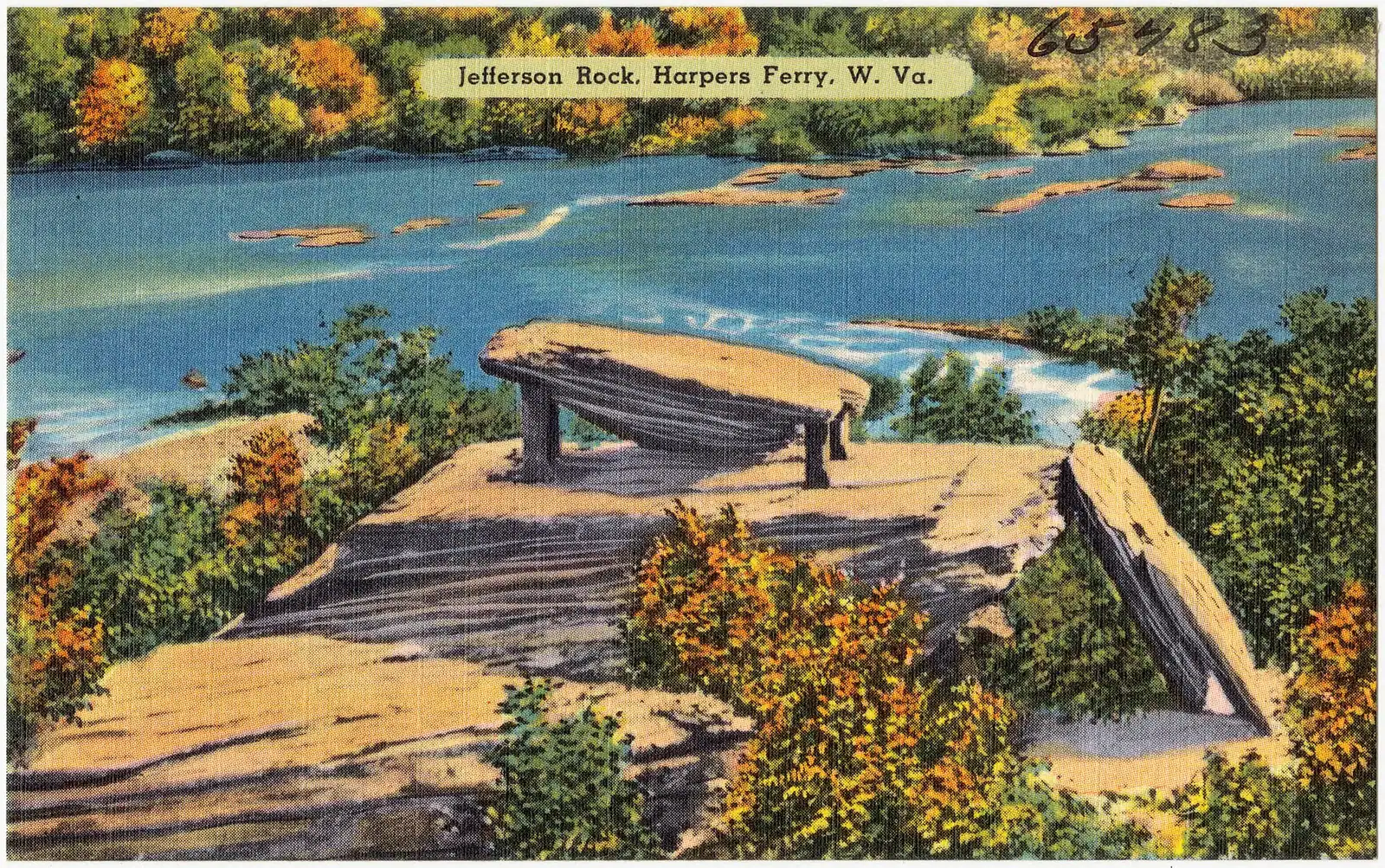
Jefferson Rock. A couple of minutes beyond that.

The whole sequence takes fifteen minutes walking and is worth forty. The Appalachian Trail uses this same line, so you will share it with people carrying large packs, particularly in late spring.
The building you are looking at is Victorian

This trips people up. The date on everything says 1833; the architecture says something several decades later. Both are right.

The 1833 church was a modest structure serving a working congregation. By the 1890s it needed work, and Thomas J. Collins — an architect active around Staunton, Virginia, with a substantial body of ecclesiastical work — was engaged to remodel it. What he did amounts to wrapping and rebuilding: stone cladding, red sandstone trim, a new spire, and the Victorian Gothic proportions that give the building its silhouette.

So the church in your photograph is 1896 over 1833 fabric. The thing that survived the war is inside the thing you can see.

The interior is worth the look if it is open: a single bright room rather than a nave with aisles, vaulted overhead, with gilded pendants and lancet windows glazed in coloured rather than pictorial glass. It is restrained, and after a morning of armoury ruins and battlefield interpretation the restraint is welcome.

The spire's position is the part that photographs well and reads oddly in person. The church stands on a narrow cut terrace with the ground falling away sharply to the Shenandoah, which is why it appears from a distance to be standing on the edge of a cliff. It more or less is.

Visiting an active church

This is not a museum and it is not a National Park Service exhibit building. It is a working Catholic church, a mission of St James parish in Charles Town, with a regular Sunday morning Mass and the occasional wedding and funeral.

We are not publishing a Mass time. An active parish adjusts its schedule, and a wrong worship time sends somebody to a locked door on a Sunday morning. If you want to attend, check with the parish in Charles Town.

Interior access is not guaranteed. The church is sometimes open to visitors outside services and sometimes not, and that is the parish's decision rather than the park's. Treat getting inside as a bonus rather than a plan.

If a service is in progress, do not go in as a sightseer. This should not need saying and occasionally does.

The exterior is always there. The spire, the terrace, the stonework and the view down to the river are on a public path and are most of what people come for.

Photography from the path is fine. Photography inside during a service is not.

Near St Peter's

Straight-line distances, so allow more on the road — the island is long and has one main parkway.

  • A river turning between steep wooded slopes in full summer leaf, seen from high ground

    Viewpoint

    Free

    Jefferson Rock

    A propped shale slab above the Shenandoah gorge, and the spot that gave American travel writing its first great sentence.

    0.5–1.5 hoursFree once you are inside the park; the park entrance fee still applies to your vehicle420 ft away

  • A whitewashed stone-walled house on a steep bank, its garden held up by a dry stone retaining wall

    Historic site

    Free

    Harper House

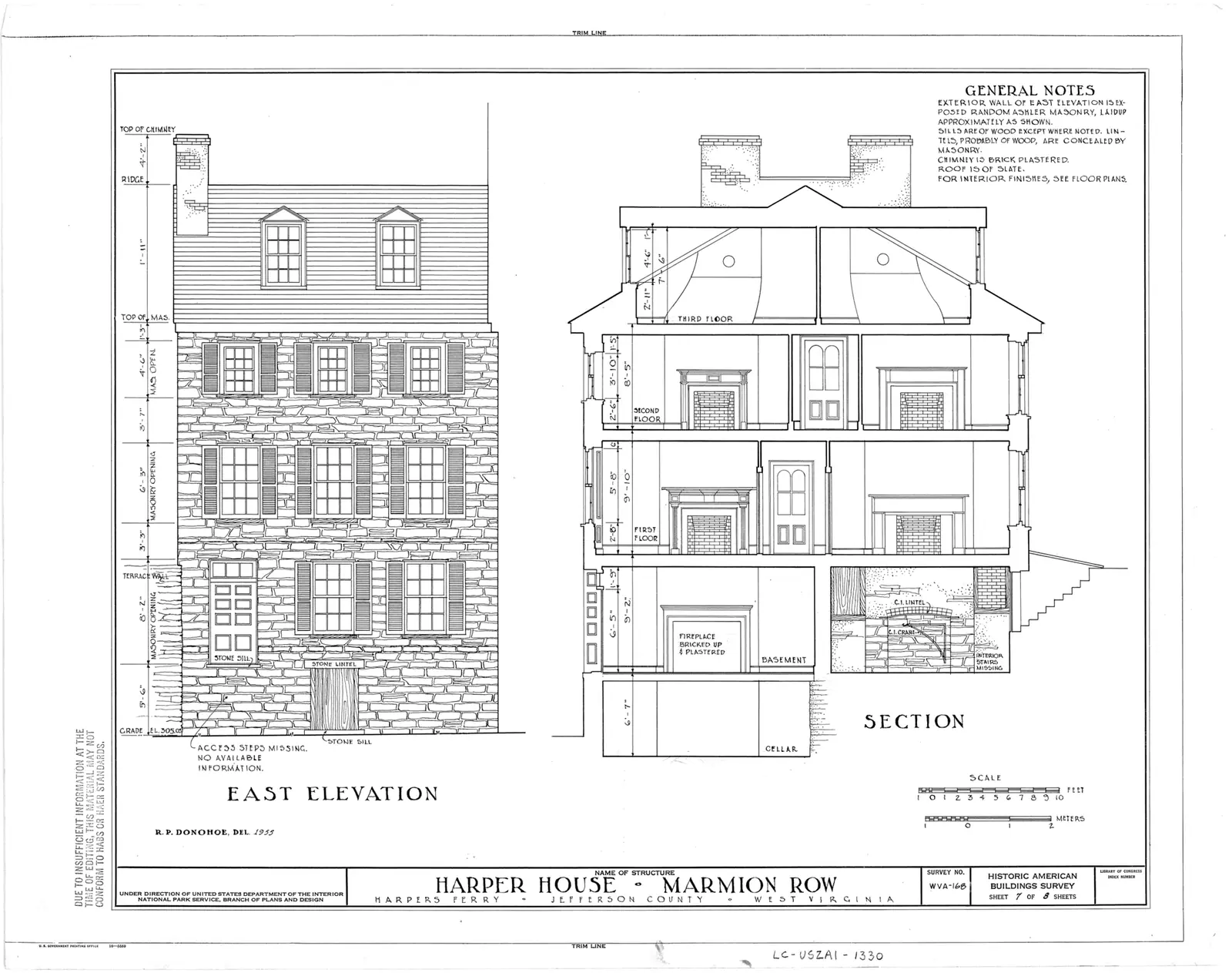
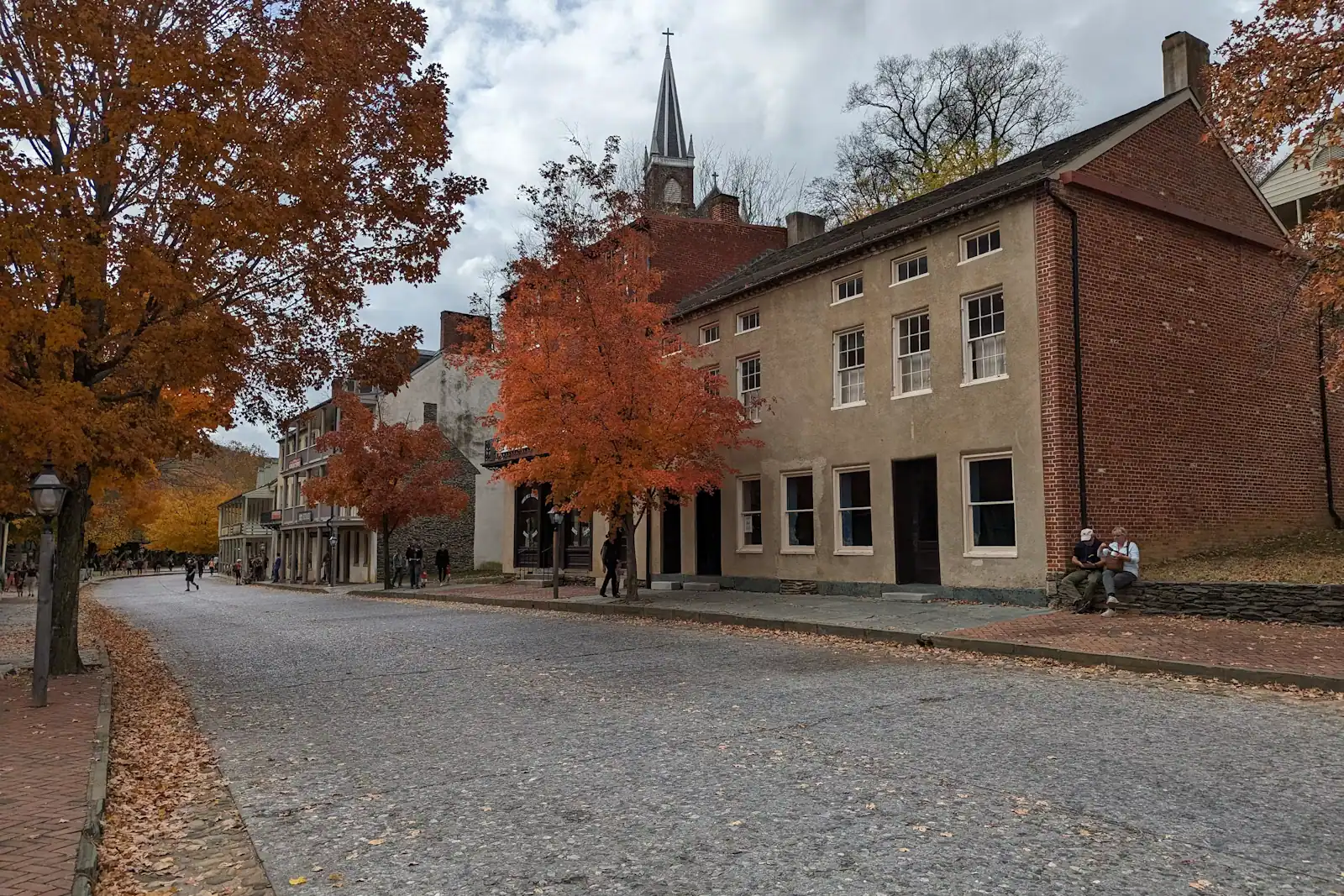
    The stone house the ferryman never finished, the oldest building in town — and shut for repairs at the moment.

    15–40 minutesNo separate charge when open; covered by the park entrance fee110 ft away

  • A narrow street of nineteenth-century shopfronts climbing between stone kerbs

    Shopping

    High Street

    The lower town's one commercial street: a stone climb of shopfronts ending at the steps up to St Peter's and Jefferson Rock.

    0.5–1.5 hoursThe street is free to walk; reaching it means entering the national historical park180 ft away

  • A whitewashed stone-walled house standing on a steep bank above a dry stone retaining wall

    Neighbourhood

    Camp Hill

    The terrace above the lower town: Storer College, the 1906 Niagara Movement meeting, and the view without the queue.

    1–1.5 hoursIncluded with park entrance; the grounds carry no separate charge0.3 mi away

St Peter's: common questions

Why did St Peter's survive the Civil War?

Nobody is certain. Harpers Ferry changed hands repeatedly and was shelled from three directions, and every other church in the town was destroyed or wrecked — the roofless shell of St John's Episcopal, two minutes further up the same path, shows what that looked like. St Peter's came through standing and served as a hospital during the fighting. The explanation usually offered locally is that the priest flew a British flag over it to claim neutrality, which is a good story that historians treat with caution.

Can you go inside St Peter's Church in Harpers Ferry?

Sometimes. It is an active Catholic church, a mission of St James parish in Charles Town, rather than a National Park Service exhibit building, so interior access is the parish's decision and varies. Treat getting inside as a bonus rather than a plan, and do not enter as a sightseer while a service is in progress. The exterior, the terrace and the view down to the Shenandoah are on a public path and available at any time the park is open.

How old is St Peter's Catholic Church in Harpers Ferry?

The original church dates from 1833 and was built for a congregation drawn largely from the Irish labourers working on the Chesapeake & Ohio Canal and the Baltimore & Ohio Railroad. What you see today, though, is a Victorian building: the architect Thomas J. Collins recased and remodelled it in 1896 in stone with red sandstone trim and the tall spire that appears in every photograph of the town taken from Maryland Heights. The 1833 fabric is inside the 1896 shell.