Most people walk off the shuttle, turn up High Street because it looks like the main street, and spend the next hour going through the story backwards. It still works. It just works less well than it could.
The lower town is small enough that the order is entirely up to you, and the order that repays the effort is chronological. Stand on the armoury ground first. Then the building. Then what the building caused. Then, up the hill, what came after the war, which is the half of the story most day-trippers never reach.
This is a full day, from the first bus to the last. Compress it to four hours by cutting everything after three o'clock.
The day at a glance
| Time | Where | Why then |
|---|---|---|
| 8.45 a.m. | Visitor centre, Cavalier Heights | Ahead of the first bus, ahead of the queue |
| 9.00 a.m. | First shuttle down | Runs every 10–15 minutes from nine |
| 9.15 a.m. | The Point, then the armoury grounds and the obelisk | Empty for another hour |
| 9.45 a.m. | John Brown's Fort | Before the coach groups |
| 10.15 a.m. | Shenandoah Street exhibit buildings | They open at nine and fill by eleven |
| 12.00 p.m. | Lunch on High Street or up in Bolivar | Kitchens are small and get slammed at one |
| 1.15 p.m. | The 1810 stone steps, St Peter's, Jefferson Rock | Climb it on a full stomach, slowly |
| 2.00 p.m. | Camp Hill: Storer College and the Conservancy | The part that changes the morning |
| 3.15 p.m. | The footbridge and the C&O towpath | Flat, shaded, and the best view back |
| 5.00 p.m. | Exhibit buildings close | Hard stop |
| 5.30–6.45 p.m. | The Point again, or the bookshops, or a drink | Summer only; in winter the bus has gone |
| Last bus | 7 p.m. summer, 5.30 p.m. winter | Do not miss it |
Morning: the ground, then the building
9.15, the Point
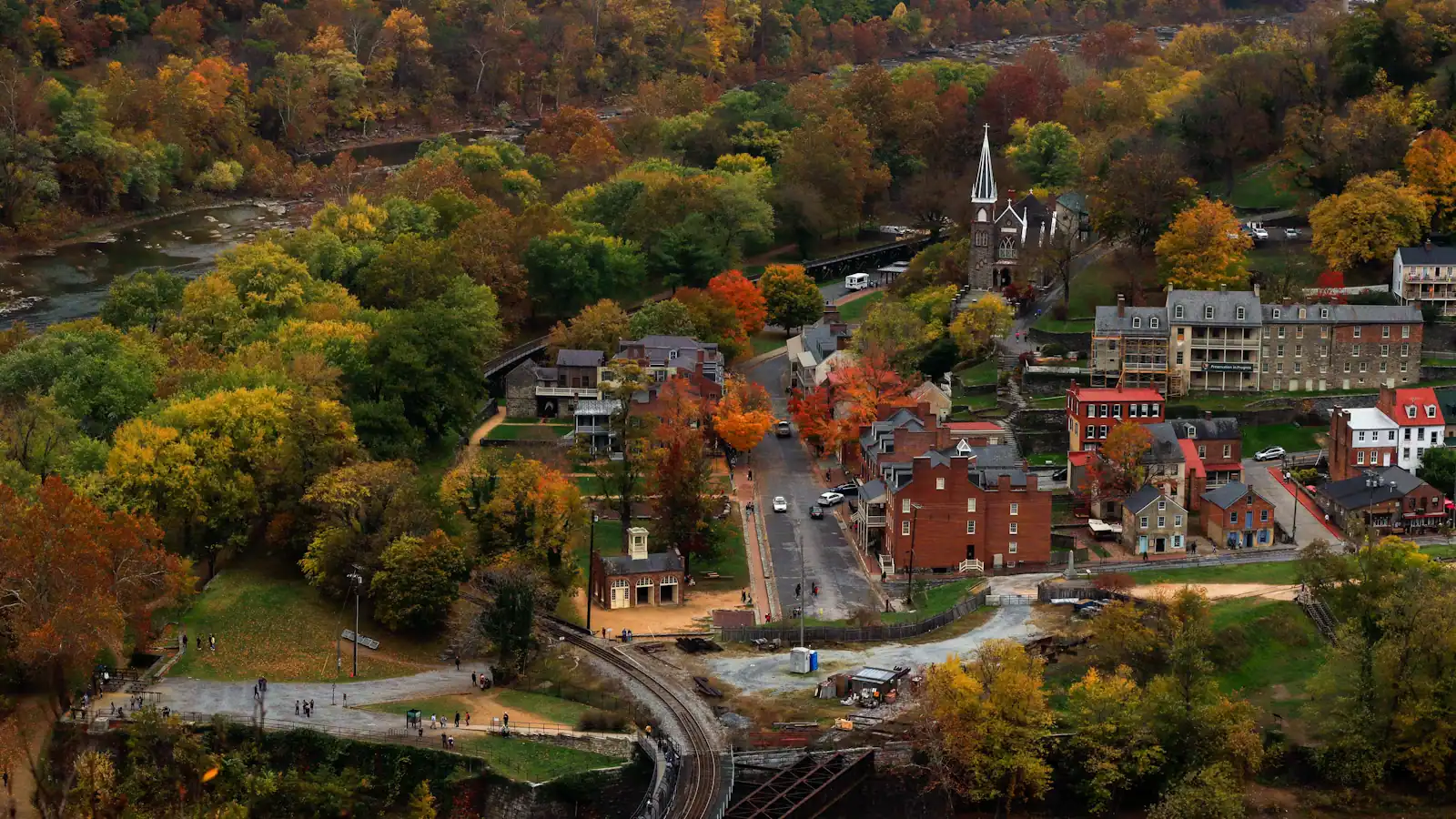
Four minutes' walk downhill from the shuttle stop and worth doing before anything else. The Shenandoah comes in from the right, the Potomac from the left, and the water in front of you is running between three states. Everything about this town — why a federal armoury was put here in 1799, why it could not be defended in 1862, why it floods — is visible in one look.
9.30, the armoury grounds
Walk east along the Potomac bank to the flat open ground under the railway embankment. This is where the armoury stood: begun in 1799, better than 600,000 muskets, rifles and pistols made here between 1801 and 1861, burned in 1861 to keep it out of Confederate hands. Find the stone obelisk. It marks the exact spot where the fire engine house stood in October 1859.
9.45, John Brown's Fort
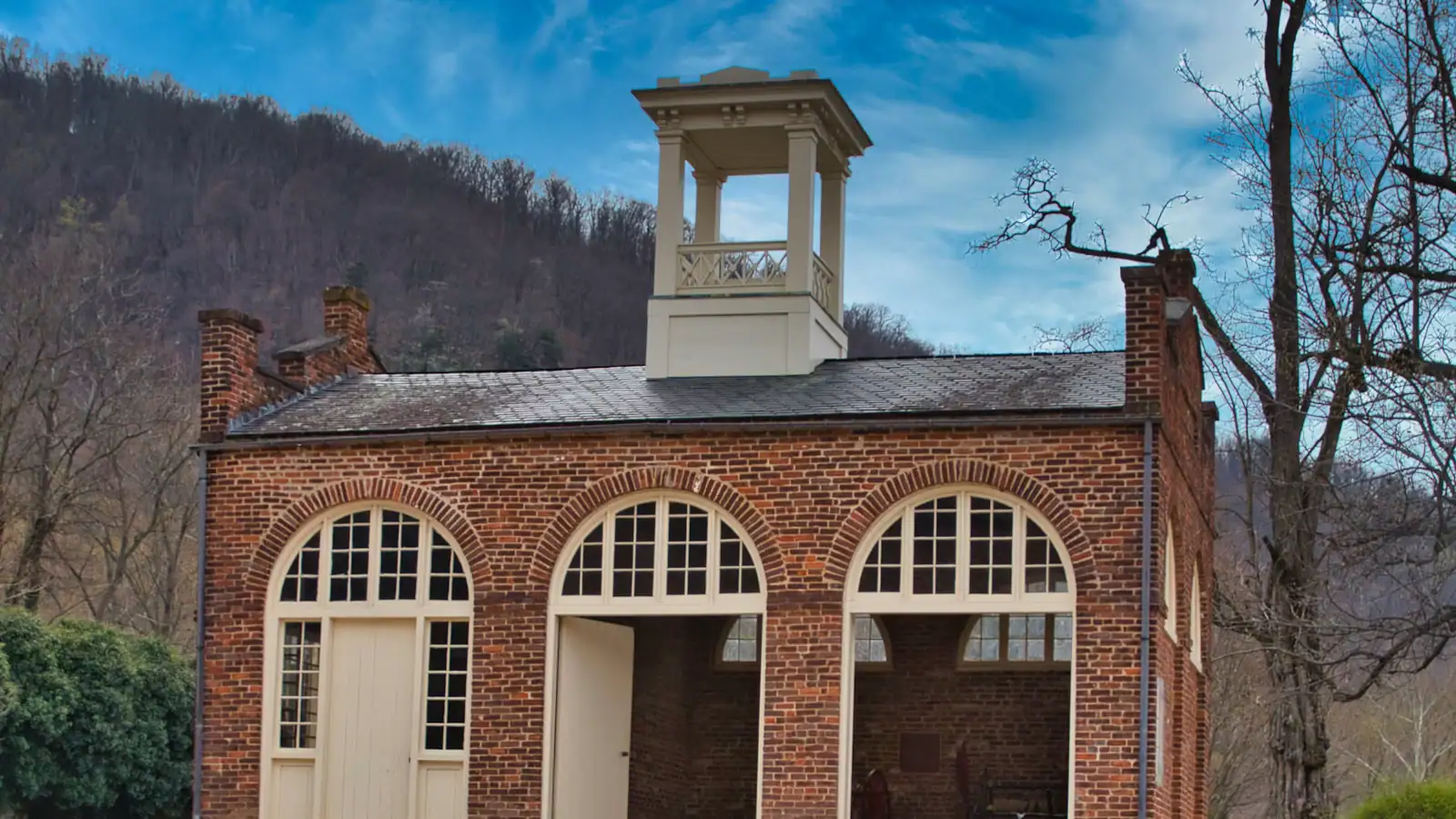
Now look at the building, which is about 150 feet west of the obelisk you were just standing at. This is the fire engine house the Marines broke into on the morning of 18 October 1859. It has been dismantled and rebuilt four times since — Chicago in 1891, a farm above town in 1895, the Storer College campus in 1909, back down here in 1968 — and a railway embankment now sits on the ground it was built on. Standing at the obelisk first is what makes that make sense.
10.15 to noon, Shenandoah Street. The exhibit buildings run along the street and each takes ten to twenty minutes. Ask at the visitor centre desk which are open on the day you come, because individual buildings close for repairs without much warning and a printed list is out of date the week it prints.
Midday: eat before one
There are not many kitchens here and they are small. High Street has a handful; Bolivar, up the hill, has more and is where residents eat. Either way, one o'clock on a Saturday is the worst possible moment to start looking. Twelve is fine. Half past eleven is better in October.
Afternoon: the stone steps, and the half of the story above them
1.15, the stone steps
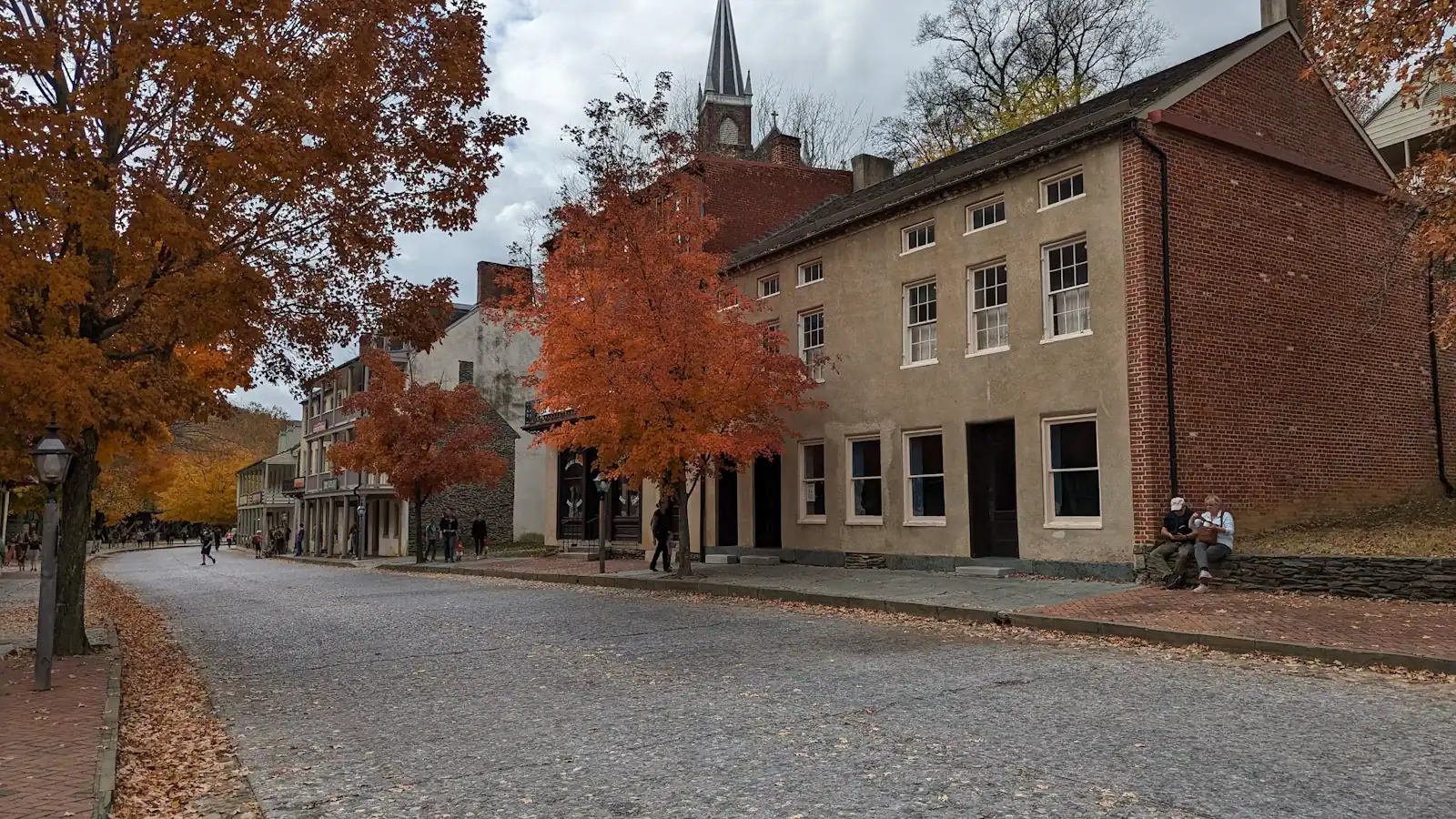
Cut into the hillside in 1810 and worn concave by two centuries of feet. They are steep, uneven and slick after rain. Take them slowly. Partway up, St Peter's Roman Catholic Church with its spire, one of the few buildings in the lower town to come through the Civil War without serious damage.
1.45, Jefferson Rock
A stacked shelf of shale on the bluff above the Shenandoah. Thomas Jefferson stood here in October 1783 and wrote a passage about the view in Notes on the State of Virginia that is still the most quoted description of the place. The rock is braced by pillars now, which were added in the nineteenth century because it was being worn away by visitors doing exactly what you are about to do.
2.00, Camp Hill
Keep climbing. The Appalachian Trail Conservancy has its headquarters up here at 799 Washington Street, and on any day between April and July there will be thru-hikers on the porch having their photograph taken for the binder. Beyond it, the old Storer College campus.
Storer opened in 1867 to educate people freed by the Thirteenth Amendment, growing from a school begun in 1865 for nineteen formerly enslaved children. In August 1906 the Niagara Movement, led by W. E. B. Du Bois, held its first meeting on American soil on this campus, and walked from here to John Brown's Fort. The college closed in 1955. The buildings have housed a National Park Service training centre since 1963.
Give this an hour. It is the part of the day most visitors skip, and it is the part that decides whether you leave with a story about one man in 1859 or with something larger.
Late afternoon: across the water
3.15, the footbridge. Back down the hill, out along the Potomac and up the steps to the footbridge that carries the Appalachian Trail across the river beside the railway bridge. Halfway across, stop and look back. That view of the town stacked up the hillside with the church spire above it is the one worth the day.
3.30, the towpath. On the Maryland bank the C&O Canal towpath runs flat in both directions, shaded, unpaved and easy. Twenty minutes upstream and back is enough to feel like you have left the crowd. It is also the only genuinely level walking in Harpers Ferry, which matters if the steps have finished somebody off.
Evening, if it is summer
Between March and early November the last bus is 7 p.m., which gives you two hours after the exhibit buildings close. Nobody uses them. The light on the water at the Point in the last hour of the day is better than anything you will see at midday, the streets are almost empty, and the bookshops in the lower town keep their own hours rather than the park's.
In winter the last bus is 5.30 p.m. and the day simply ends when the buildings do.
The four-hour version
Cut the afternoon, not the morning.
Arrive for the first shuttle at nine. Do the Point, the armoury grounds and the obelisk, John Brown's Fort and two or three exhibit buildings on Shenandoah Street. Take the stone steps as far as Jefferson Rock, which is about twenty minutes up and fifteen down. Eat at half past eleven, before the kitchens fill. Leave at one.
What you lose is Camp Hill, and you should know that is what you are losing. Storer College and the 1906 meeting are the consequence of the morning, and a visit that stops at the fort ends the story in 1859.
If four hours is genuinely all you have and the history is why you came, consider swapping the footbridge for Camp Hill instead. The view from the bridge is the better photograph. The hill is the better afternoon.
If it rains
The stone steps and the cobbles become genuinely slippery wet, and the exposed shale at Jefferson Rock is worse. Maryland Heights in rain is not worth attempting; the upper section is loose and the overlook shows you cloud.
The day still works. Exhibit buildings are indoors, the shuttle is covered, the lower town bookshops are dry and the museums are the whole point for at least a third of the people here. Add the Charles Town courthouse, eight miles away, or drive the 17 miles to Antietam where the visitor centre and the driving tour are mostly under cover.
What rain does change is the river. After heavy rain upstream the Shenandoah rises fast and outfitters cancel trips on water level rather than on weather. If a rafting booking is the centre of your day, call them rather than looking out of the window.
Last updated
Opening hours, ordinances and prices move with the season. We re-check this guide rather than rewrite it, and the date above is the last time someone did. How we research and correct.