Skip to content
Menu

A booking made through these earns us a commission from Viator. The price is the same, and the commission had no bearing on what is recommended.

Neighbourhood

Charles Town

Last updated

Eight miles west: the courthouse where John Brown was tried, the ground where he was hanged, and a Washington family town.

The story that starts in the lower town finishes here. After the Marines broke into the engine house on 18 October 1859, John Brown was taken eight miles west to Charles Town, the seat of Jefferson County, tried at the county courthouse over about a week, convicted of treason against the Commonwealth of Virginia, murder and inciting insurrection, and hanged on 2 December in a field at the edge of the town. Six of his men were tried and executed afterwards.

Most visitors to Harpers Ferry never come. That is a mistake, because the raid is only half a story without its consequences, and the consequences were legal, public and deliberate. Virginia wanted a trial rather than a lynching, and it wanted it fast. Brown's conduct in the courtroom and the letters he wrote from the jail did more to shape northern opinion than the raid itself had, and by the time he was hanged, with Virginia militia drawn up around the scaffold and the town closed to outsiders, he was already becoming the figure the next four years would argue about.

The town itself predates all that by seventy years. Charles Washington, the youngest brother of George, laid it out in 1786 on eighty acres of his land and donated the four corner lots at George and Washington Streets for public buildings. One of those lots holds the courthouse. The Washington family owned a good deal of this county, and the connections are thick on the ground: Harewood, a few miles out, is where Dolley Payne Todd married James Madison in 1794.

Modern Charles Town is the practical town of the area, with a population of 6,534 at the 2020 census and growing quickly as Washington commuters push west. It has the supermarkets, the hospital and the chain hotels that Harpers Ferry does not, plus a casino and racetrack that have been on the same site since 1933.

Allow two hours for the historic centre. Longer if you stay to eat.
Getting there and parking

About eight miles west of Harpers Ferry on US 340, fifteen minutes on a normal day and longer in the weekday commuter peak, when this road carries a great deal of traffic towards Virginia.

Park in the historic centre near the courthouse; on-street parking and small lots are generally straightforward outside court business hours. The commercial corridor and the racetrack have their own large lots.

Rideshare coverage in Jefferson County is at its best here, because this is where the drivers are, which makes Charles Town the most practical place to base a car-free trip if you are prepared to ride in and out of Harpers Ferry.

Charles Town is also the natural stop on the way to or from Dulles via Route 9, if you are building it into an arrival or departure day.

The courthouse and the trial

The Jefferson County Courthouse stands on the corner of George and Washington Streets, on one of the lots Charles Washington gave the town, and it is still the working county courthouse. That is the first thing to understand about visiting: this is not a museum. It is a building where people go about county business.

Brown was tried here between late October and early November 1859, wounded, lying on a cot in the courtroom for part of the proceedings. The trial ran fast by any standard, and the speed was the point: Virginia wanted the matter closed before it became a national argument. It became one anyway.

The building has been altered since, damaged in the Civil War and repaired, so you are not looking at an unchanged 1859 interior. What you are looking at is the site, and the continuity of use, which is stranger and more affecting than a preserved room would be.

The Jefferson County Museum in the town holds material relating to the trial and the execution, including items associated with Brown's last days. We are not going to list a specific artefact or promise you it is on display, because small local museums rotate and change. Check hours before you travel; institutions of this size in a town of this size keep limited and seasonal schedules.

Where he was hanged, and what is there now

This needs saying plainly, because visitors go looking and are disappointed or, worse, intrusive.

Brown was hanged on 2 December 1859 in a field then at the edge of the town. The town has since grown over it. The site is now occupied by the Gibson-Todd House, which is a private residence. There is no visitor centre, no gallows reconstruction and no ticket. It is somebody's home.

Look from the street. Do not go up the path, do not photograph through windows, and do not knock. A marker in the vicinity explains what happened here, and that is the extent of what the site offers a visitor.

What the ground gives you, if you stand on the pavement and think about it, is scale. Virginia put fifteen hundred troops around this execution because it was afraid of a rescue attempt, and a young actor named John Wilkes Booth talked his way into a militia uniform to watch. Brown handed a note to a guard that morning predicting that the crimes of this guilty land would not be purged away but with blood. Sixteen months later the war began.

Stand for a minute. Then go and find lunch.

A town the Washingtons built

Strip out 1859 and Charles Town is still one of the more interesting small towns in the Eastern Panhandle, because the Washington family is all over it.

Charles Washington came out here in the 1780s and laid out the town on his own land in 1786, naming the streets for members of his family. Walk the grid and you are walking a family tree: George, Charles, Samuel, Mildred, Lawrence. Several Washington relatives are buried in the town, and Washington family houses stand in the surrounding county, most of them privately owned and visible only from the road.

Harewood, built for George Steptoe Washington, is the best known. James Madison married the widowed Dolley Payne Todd there in 1794, which makes a farmhouse outside Charles Town the wedding venue of a future president and one of the more consequential first ladies in American history. It is a private home and not open to visitors.

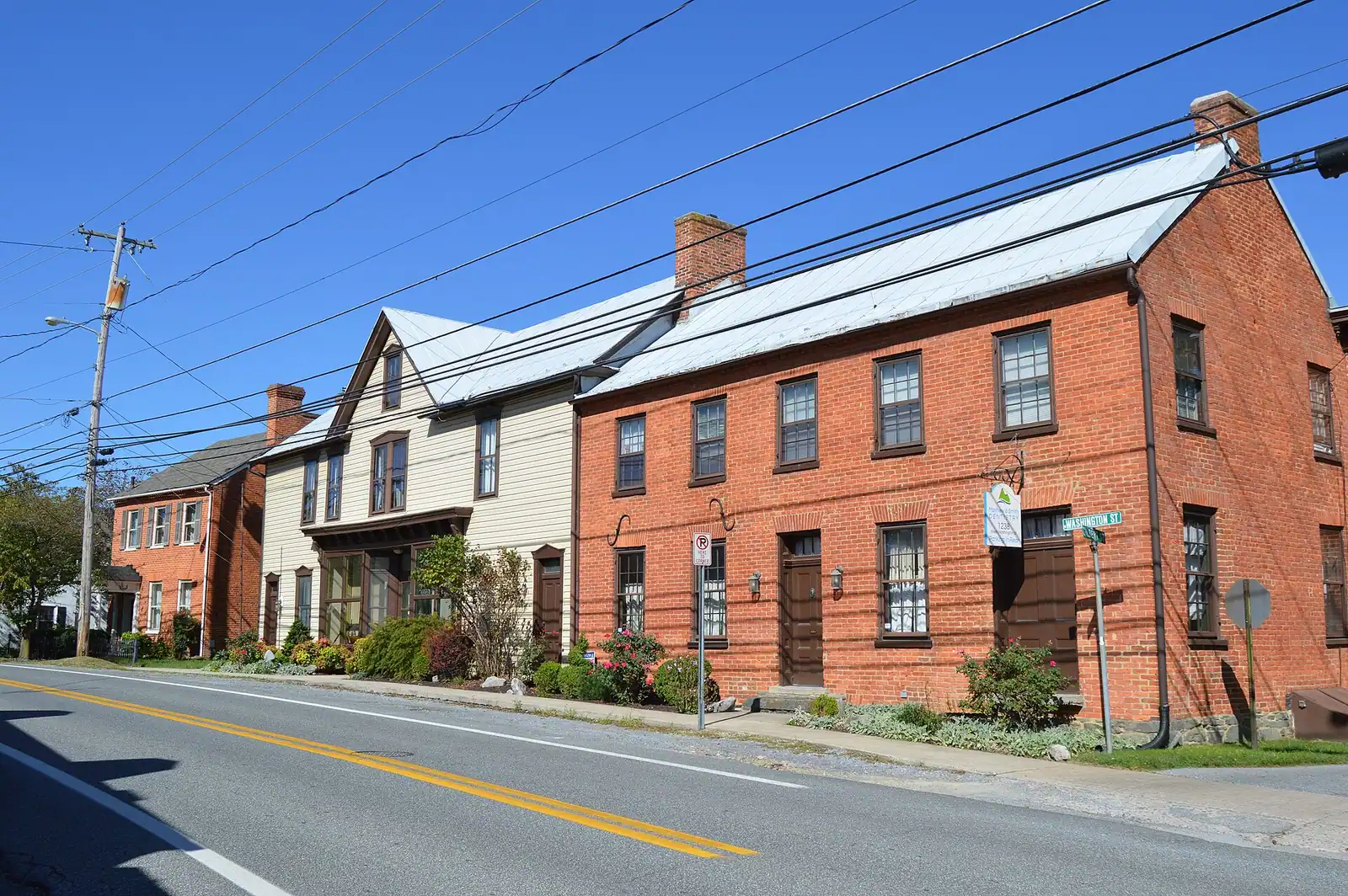
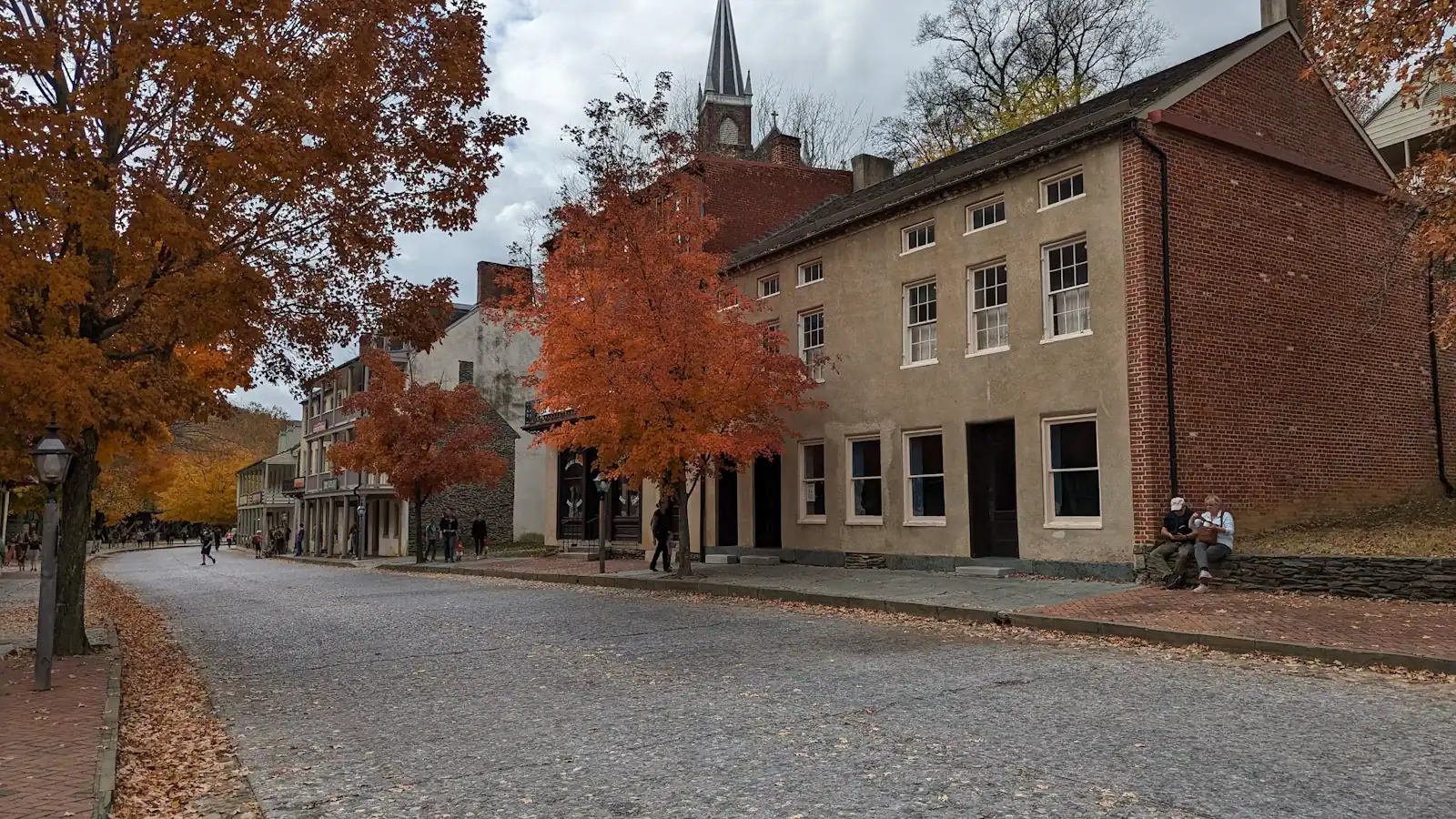
The historic centre is compact and walkable: brick commercial frontages, the courthouse, churches with old burying grounds, and a scale that has survived the county's growth reasonably well.

Give it an hour on foot with a map from the museum or the visitor information point. It is a better town to walk than to drive through, and it is the most straightforward thing to do in Jefferson County on a wet afternoon.

The racetrack, and the other side of town

There are two Charles Towns and it is worth knowing which one you are heading for.

One is the eighteenth-century county seat with the courthouse and the Washington streets. The other is the commercial corridor along the highway, where the supermarkets, the hospital, the chain hotels and Hollywood Casino at Charles Town Races are. They are a couple of miles and about two centuries apart.

The racetrack is the older of the modern attractions: thoroughbred racing has run on that site since 1933. Slot machines arrived after West Virginia legalised them at racetracks in the late 1990s, the Hollywood branding came in 2010, and the result is a substantial casino and hotel complex that draws a good deal of traffic from Washington and Baltimore.

For a visitor based in Harpers Ferry, its real usefulness is unglamorous. This is where the hotel rooms are. Harpers Ferry and Bolivar between them hold a small number of inns, bed and breakfasts and short-term rentals, and on a peak October weekend they are gone months ahead. Charles Town has capacity.

It is also where the practical shopping is. If you need a chemist, a supermarket, petrol or a hardware shop while staying in Harpers Ferry, this is the drive you make.

Near Charles Town

Straight-line distances, so allow more on the road — the island is long and has one main parkway.

  • A walker carrying a full pack on a trail above a river, trees thick on the far bank

    Neighbourhood

    Free

    Bolivar

    A separate town on the ridge above the lower town, four times the size of Harpers Ferry, where the rooms and the kitchens actually are.

    1–3 hoursFree. Bolivar is a town, not a park site, and carries no entrance fee6.5 mi away

  • A street of nineteenth-century brick and stone frontages with stone kerbs

    Neighbourhood

    Free

    Shepherdstown

    Chartered in 1762, a university on the main street, and the town that absorbed the wounded from Antietam two days after the battle.

    1.5–4 hoursFree. There is no entrance fee to the town10.2 mi away

  • A whitewashed stone-walled house on a steep bank, its garden held up by a dry stone retaining wall

    Historic site

    Free

    Bolivar Heights

    Flat, open and five minutes from the car park: the battlefield where a Union garrison of 12,500 surrendered in two days.

    1–1.5 hoursNo separate charge; covered by the park entrance fee, which is valid three consecutive days6.2 mi away

  • A plain church with a steep roof and a spire standing above a wooded slope

    Historic site

    Antietam National Battlefield

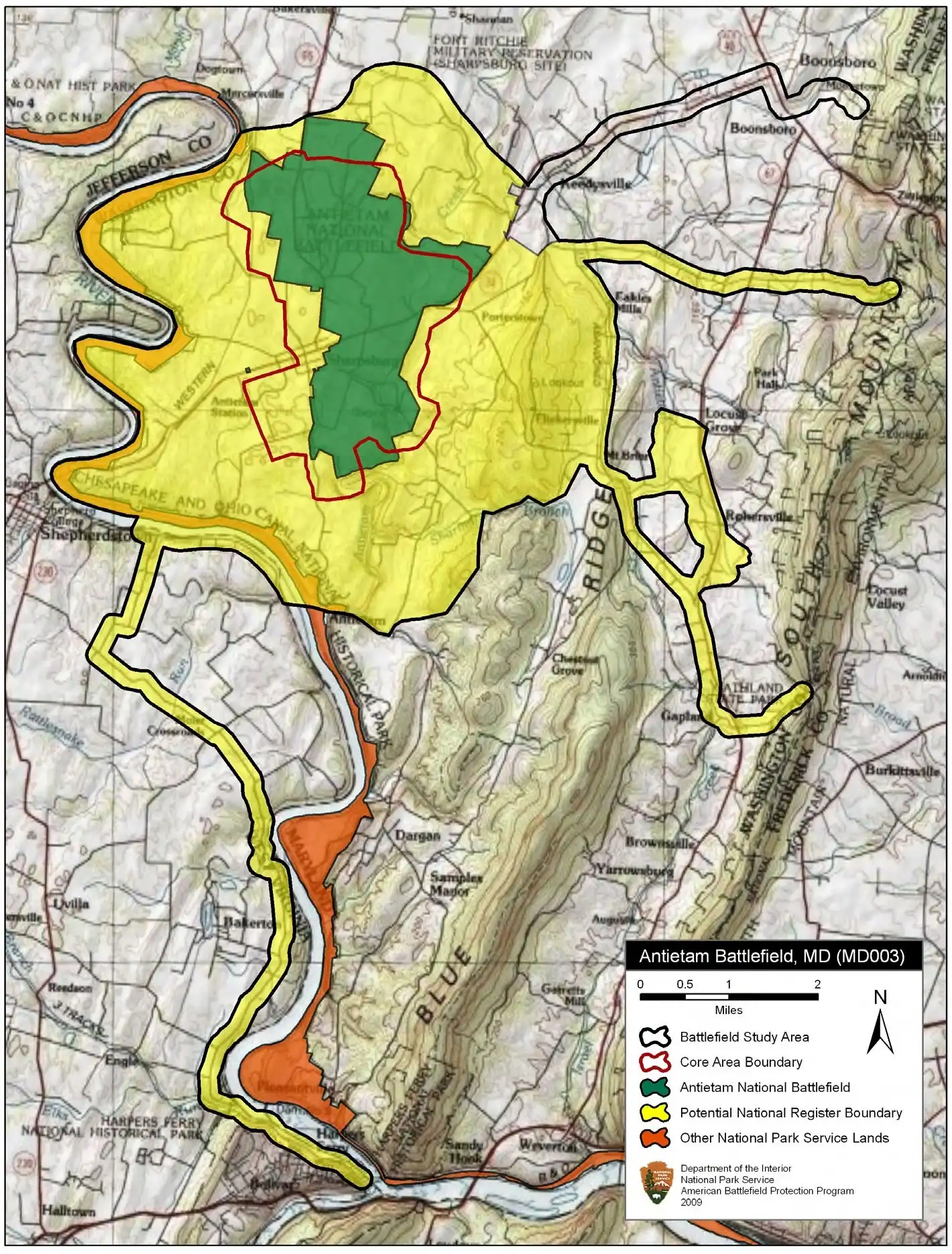
    Roughly 23,000 casualties in one September day, half an hour north of Harpers Ferry, and the same campaign that took this town.

    2.5–6 hoursAt the time of writing: $20 per private vehicle, $15 per motorcycle, $10 per person on foot or bicycle, each valid three consecutive days14.2 mi away

Charles Town: common questions

Where was John Brown hanged?

In a field at the edge of Charles Town, eight miles west of Harpers Ferry, on 2 December 1859. The town has since grown over the site, which is now occupied by the Gibson-Todd House, a private residence. There is no visitor centre or reconstruction, and you should view it from the public pavement only. A marker nearby explains what happened. Brown was tried at the Jefferson County Courthouse on George and Washington Streets.

Can you visit the courthouse where John Brown was tried?

The Jefferson County Courthouse still stands on the corner of George and Washington Streets and is still the working county courthouse, so it is a functioning public building rather than a museum. It was damaged in the Civil War and altered since, so the interior is not an unchanged 1859 courtroom. Contact the county directly about access, and check the Jefferson County Museum in the town, which holds material relating to the trial.

How far is Charles Town from Harpers Ferry?

About eight miles west on US 340, roughly fifteen minutes outside the commuter peak and noticeably longer during it. It is the nearest town of any size to Harpers Ferry and the place to go for a supermarket, a chemist, petrol or a chain hotel. Rideshare coverage in Jefferson County is best around Charles Town and Ranson, since that is where the drivers actually live.

Why is Charles Town called Charles Town?

After Charles Washington, the youngest brother of George Washington, who laid the town out in 1786 on eighty acres of his own land and donated the four corner lots at George and Washington Streets for public buildings. He named the streets for his family, so the grid reads as a Washington family tree. Several Washington relatives are buried locally, and Harewood, where Dolley Payne Todd married James Madison in 1794, stands a few miles out.