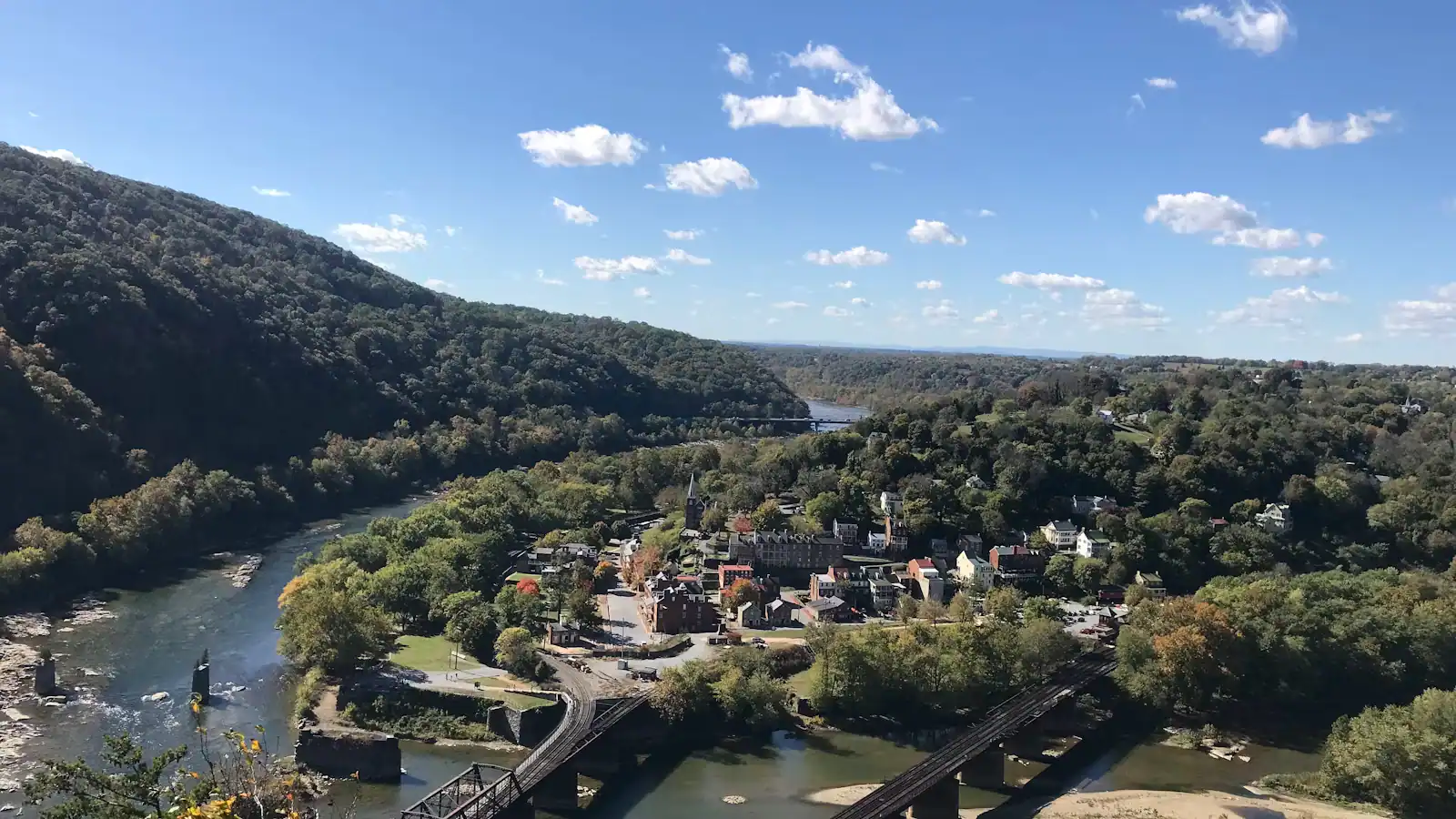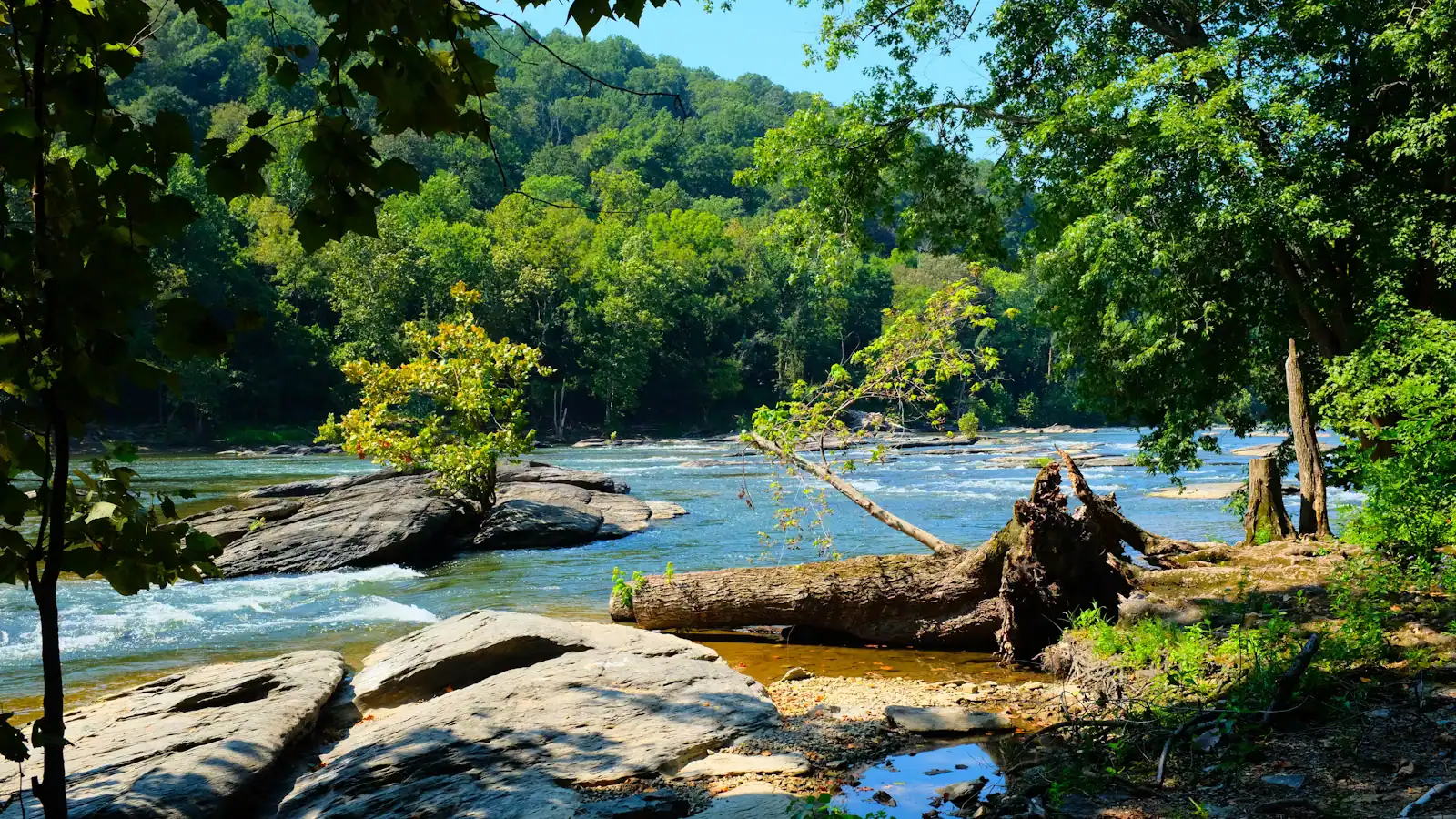
Ask when to come to Harpers Ferry and the honest answer is a question back: which of the three do you want?
The rivers run highest in spring and are warmest and lowest in July. The ridges colour in October. The Appalachian Trail is a moving crowd of thru-hikers from April into July and nearly empty otherwise. The history is available every day of the year, and is best in the months when nobody else is here. Four calendars, none of them aligned, and the shuttle clock changing underneath all of them.
The year in one table
| Month | Rivers | Colour and light | Crowd | Come for |
|---|---|---|---|---|
| January | high, cold, no trips | bare, long views | almost none | the town to yourself |
| February | high, cold | bare | very light | empty exhibits, fee-free 16 February |
| March | spring run-off begins | first green late | light, building | clocks forward 9 March, evenings open up |
| April | run-off, class II–III+ | new leaf | moderate | first thru-hikers, high water |
| May | strong, guided season underway | full green | busy weekends | the trail at its busiest, best walking |
| June | dropping, warm | full green | busy | long evenings, the 7 p.m. last bus |
| July | low and warm, tubing season | heavy canopy, haze | busy, hot | the river, early mornings only |
| August | lowest | tired green | moderate | fee-free 25 August, quiet weekdays |
| September | rising, clearing | first turn high up | building | siege anniversary, best all-round month |
| October | clear and cold | peak, ridges first | the year's busiest | the colour, and the queue |
| November | cold | bare after mid-month | dropping fast | clocks back 1 November, open views |
| December | cold, high | bare | almost none | 2 December anniversary, empty streets |
Spring, which belongs to the water and the walkers
March, April and May
March is the month the evenings come back. Daylight saving starts on 9 March in 2026, and the last shuttle out of the lower town moves from 5.30 p.m. to 7 p.m. that weekend. That single change does more for what a day here can hold than any amount of weather.
April and May are the high-water months. The lower Shenandoah runs class I to III in season and higher during the spring run-off, which makes April the month for guided rafting and a poor month for tubing. Outfitters run on river level rather than on the calendar, and a warm April weekend can be cancelled on water while a cool one goes ahead.
It is also thru-hiker season. Northbound walkers on the Appalachian Trail come through from roughly April into July, heaviest in May and June, and the Conservancy porch up on Camp Hill is the busiest it gets. If you want to see the trail as a working thing rather than a line on a map, this is the window.
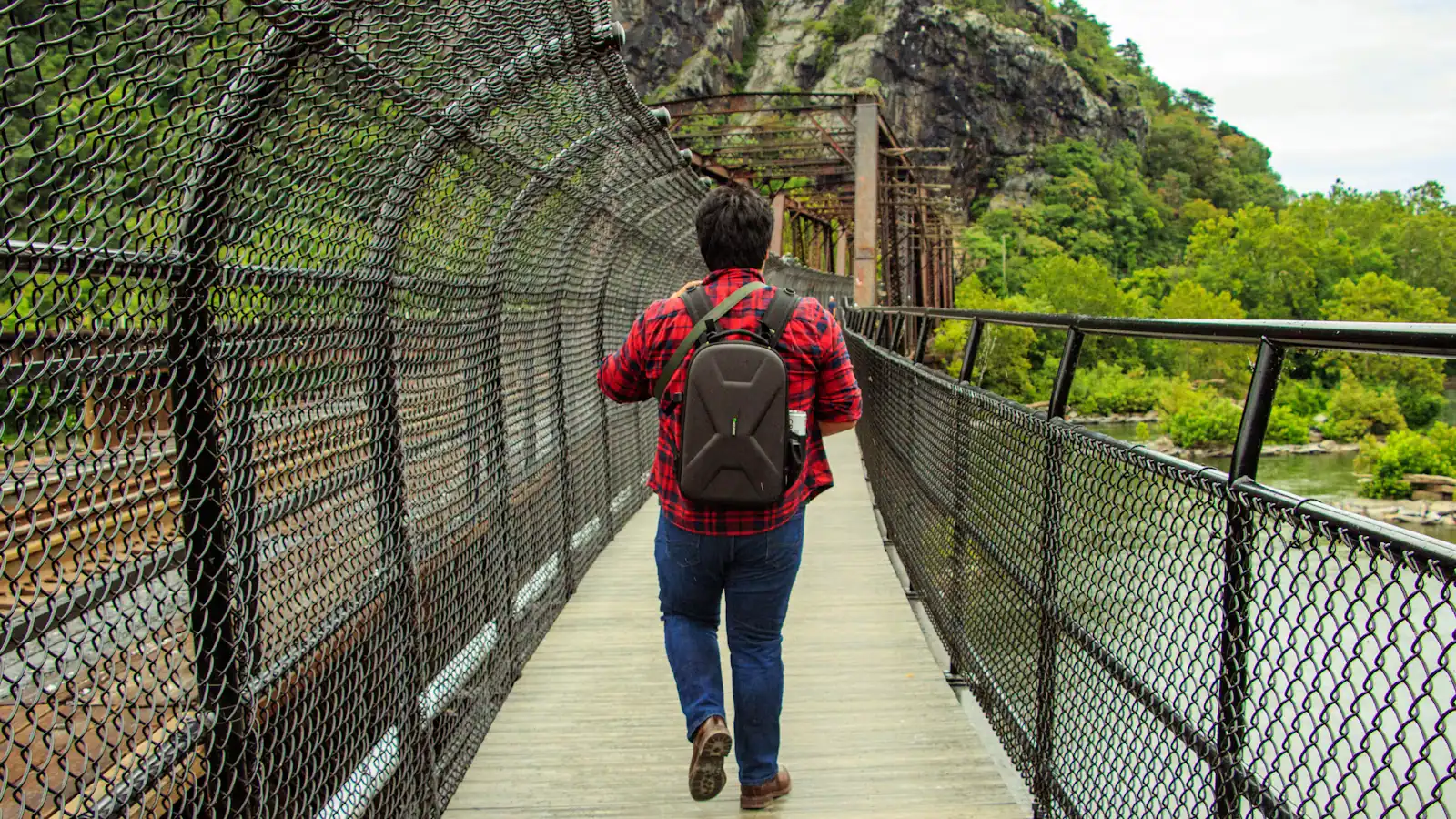
May and June are the best months for walking the heights: everything is green, the ground is dry, and it is not yet the sort of heat that makes a thousand-foot climb under closed canopy a bad idea.
Summer, which is about the hour rather than the month
July and August
These months are hot and humid in a way that a river gorge amplifies rather than relieves. The lower town sits in a bowl and holds heat. The climbs get genuinely uncomfortable after about ten in the morning, and heat exhaustion on Maryland Heights is a routine occurrence rather than a rare one.
The answer is not to avoid summer. It is to do the climbing at eight and the rivers at two.
This is the tubing season proper: the Shenandoah drops and warms, and a two-hour float is the best thing on offer for families. Book ahead for weekends. June has the longest evenings of the year against a 7 p.m. last bus, which means the lower town after five — when the exhibit buildings have closed and almost everyone has gone — is quiet, cool and empty. Nobody uses those two hours and they are among the best of the year.
August is quieter than July. Fee-free day on 25 August, the Park Service's birthday, is the exception.
Autumn, the best and the busiest
September, October and November
September is the most underrated month on this list. The humidity breaks, the water clears, the crowds have not arrived, the trails are dry and the highest ground starts to turn at the very end of it. It is also the anniversary month: the siege ran 12 to 15 September 1862 and ended with over twelve thousand Union troops surrendering on Bolivar Heights, and Antietam followed on the seventeenth, seventeen miles north.
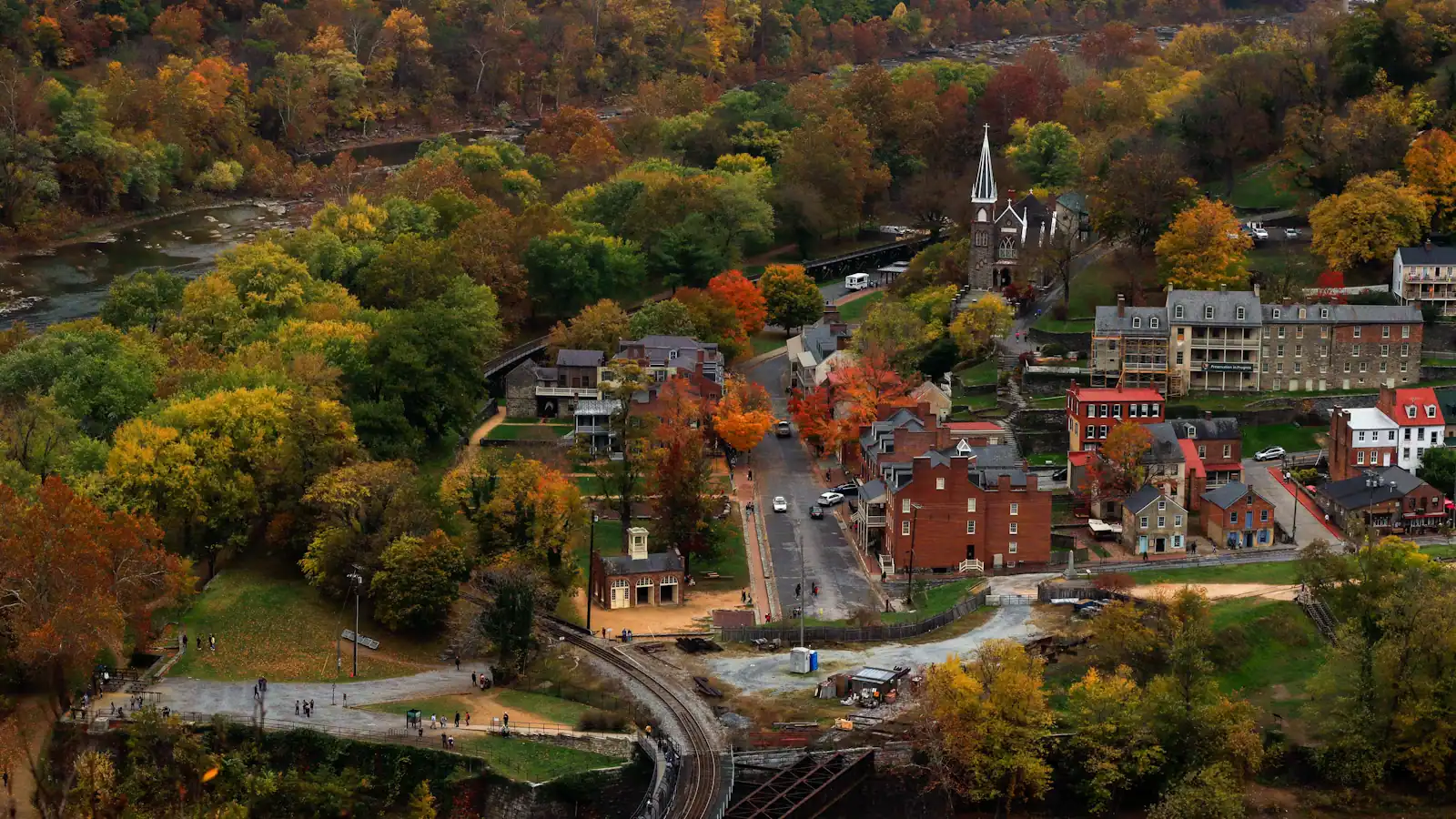
October is the peak of the year for colour and for crowds simultaneously. The ridges turn a week to ten days before the town does, so early October belongs on the heights and late October in the streets. Weekends between ten in the morning and two in the afternoon are the hardest hours of the Harpers Ferry year. Weekdays are fine.
November splits down the middle. The first half still has colour in the lower town and on the riverbank. After that the leaves go and the views from all three heights open up completely, which is its own reward. The important date is 1 November, when daylight saving ends and the last shuttle drops back to 5.30 p.m. overnight.
Winter, which is the historian's season
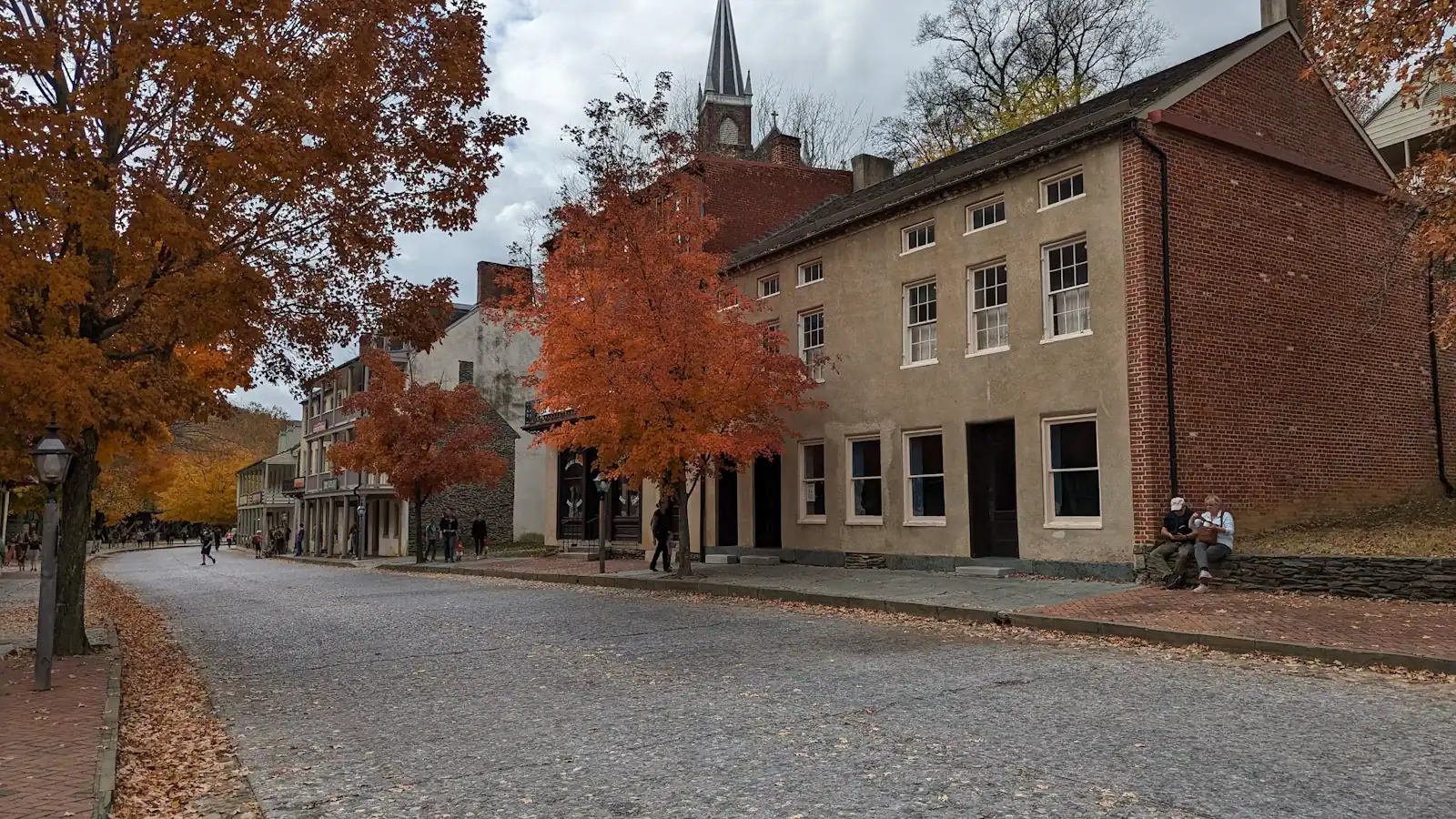
The park is open year-round and closes only on Thanksgiving, 25 December and 1 January. January and February on a weekday can mean having an exhibit building to yourself and a ranger with time to talk, which is a materially better experience of this place than an October Saturday.
The trade-offs are real and worth stating. The last bus is 5.30 p.m. and the light goes before five. Several restaurants reduce to weekend-only hours. Ice on the stone steps and on shaded upper trail sections is a genuine hazard while the town itself looks perfectly clear. And the heights in a hard frost are not the place to test a pair of trainers.
Two dates give winter a shape. 2 December is the anniversary of John Brown's execution at Charles Town, eight miles away, and 16 February is a fee-free day.
Fee-free days in 2026, and why they cut both ways
The park waives entrance on 16 February, 25 May, 14 June, 3 to 5 July, 25 August, 17 September, 27 October and 11 November. From this year the waiver applies to US citizens and residents only.
A fee-free day saves a family $20. It also puts a crowd through one parking lot and one shuttle service. On 27 October — a Tuesday in peak leaf season — the two effects collide, and it will be the busiest weekday of the autumn. If you are coming for quiet, come the day before.
Pick by why you are coming
For the history. Any month. Best in January, February and September, when you can read a panel without somebody standing in front of it. Avoid October weekends entirely.
For the walking. May, early June, late September and early October. Dry ground, full daylight, and temperatures that make a thousand-foot climb reasonable.
For the rivers. April and May for guided whitewater on the run-off. July and August for tubing, when the Shenandoah is low and warm. Book on river level, not on forecast.
For the colour. Mid-October on the heights, late October and early November in the town. Weekdays.
For the Appalachian Trail as a living thing. May and June, when the northbound thru-hikers come through.
For the lowest cost. A fee-free day outside October, and a three-day vehicle pass used across a weekend rather than a single afternoon.
Two dates to write down
9 March 2026 — daylight saving begins. The last shuttle from the lower town moves from 5.30 p.m. to 7 p.m. From this weekend the day has an evening in it.
1 November 2026 — daylight saving ends. The last shuttle goes back to 5.30 p.m. overnight, in the middle of the busiest fortnight of the year, and this catches out more visitors than anything else on this site.
The trails themselves do not follow the clock. They open thirty minutes before sunrise and close thirty minutes after sunset all year, which means that in November you can still be legally walking after the bus that reaches your car has stopped. Plan backwards from the bus, never from the light.
The park closes completely on Thanksgiving, 25 December and 1 January. Those are the only three days.
Last updated
Opening hours, ordinances and prices move with the season. We re-check this guide rather than rewrite it, and the date above is the last time someone did. How we research and correct.