Curated Catalog
New River Gorge ATV Adventure Tour (opens in a new tab)
With over 100 miles of trails ranging from beginner to expert, incredible guides, and top of the line ATV's, riders of all skill levels…
3–4 hours
Prices checked
A booking made through these earns us a commission from Viator. The price is the same, and the commission had no bearing on what is recommended.
Water feature
Last updated
Class I to III through the Staircase, Bull Falls at the bottom, and the only thing in this town with much to book.
Photo: Young Chuck, U.S. Fish and Wildlife ServicePublic domain
The Shenandoah arrives at Harpers Ferry having run north-east for a hundred and fifty miles up its own valley — one of the minority of American rivers that flows broadly northward — and it spends its last few miles doing something more interesting than it has done anywhere else. Below Millville the river drops over a series of ledges known as the Staircase, a Class I to III run with Bull Falls as the hardest single drop, and then joins the Potomac at the foot of the town.
This is the commercial heart of Harpers Ferry, which surprises people who come for John Brown. Strip the Washington DC listings out of the bookable market here and almost everything left is water: guided rafting, tubing, funyaks, kayak instruction and float trips. The history is free and the river is what has a price on it.
The run itself is not frightening and it is not trivial either. Class III at the top of the range means real whitewater — waves that will fill a raft, a drop that requires a line — and the Staircase rewards a guide who knows which channel is working at the current level. At lower summer flows the same water turns into a bouncy, warm, entirely family-tolerable float, which is why the same stretch of river is sold as an adrenaline trip in April and a lazy tube run in July.
The variable is flow, and this is the single most important thing on the page. Nobody here runs to a calendar. Outfitters read the gauge. Spring snowmelt off the Blue Ridge and spring rain give the highest and coldest water of the year, and an early-April trip can be cancelled, downgraded or upgraded at short notice. By late June the river has usually dropped into tubing flow. A dry August can leave sections too bony to run at all, and a summer thunderstorm over the valley can put it back up within a day.
Upstream of the ledges, the river is also a quiet smallmouth bass fishery, and a good one.
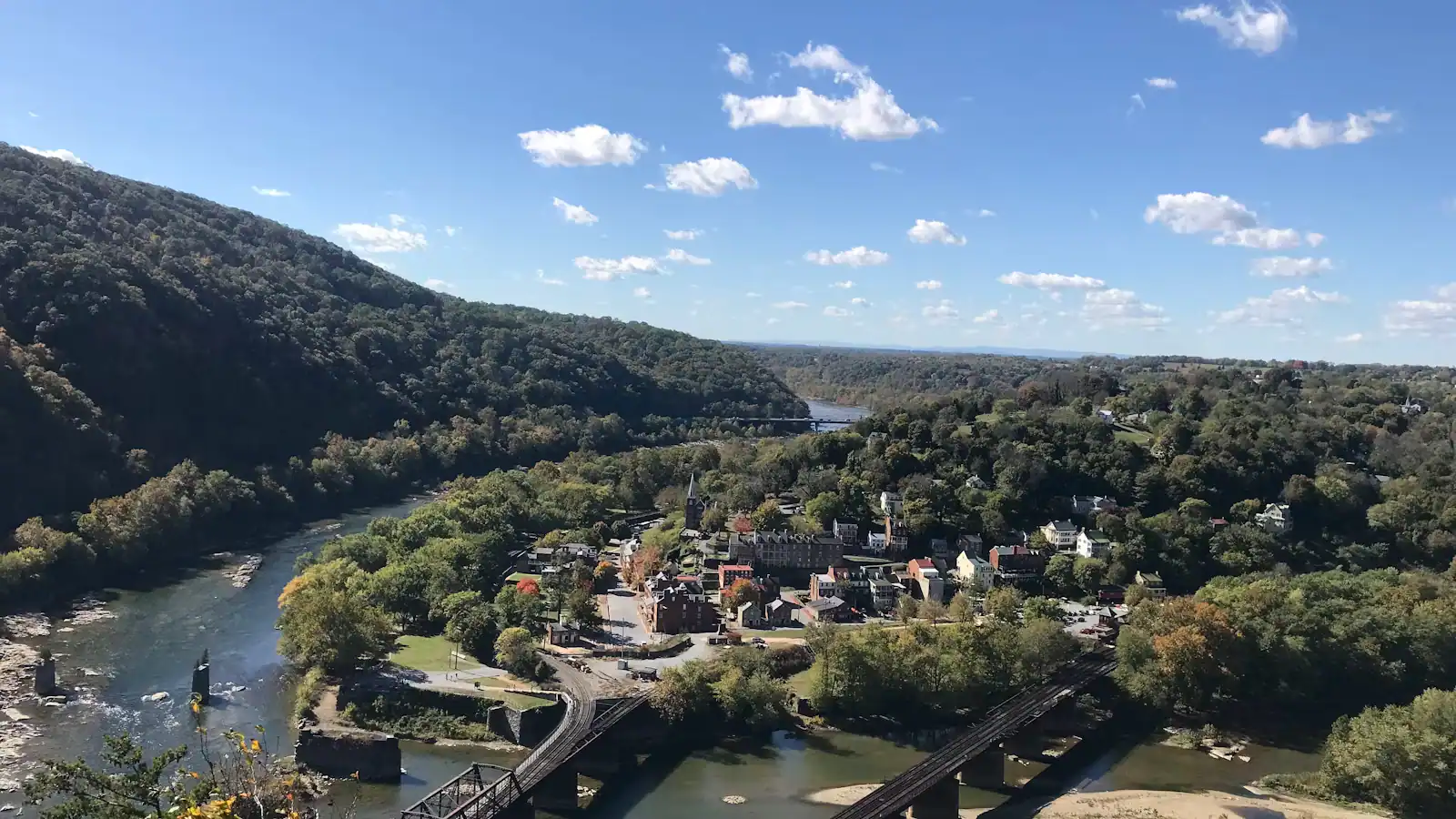
For the river itself, no travel is needed: the Shenandoah runs along the south edge of the lower town and you can stand beside it on the level walk out to Virginius Island, or look down the last of the Staircase from The Point at the confluence.
For a trip on it, outfitters are based upstream around Millville and along the West Virginia bank, several miles from the historic district, and almost all of them run their own shuttle from a meeting point. Book first and follow their directions rather than driving to the water and hoping.
Do not plan to park in the lower town and walk to a put-in. The commercial run starts well upstream and the shuttle arrangement exists for that reason.
If you are combining a river trip with the park in one day, take the river in the morning and the town in the afternoon. The bowl holds heat, the museums are indoors, and the last shuttle up to Cavalier Heights leaves the lower town at seven in summer and half past five in winter.
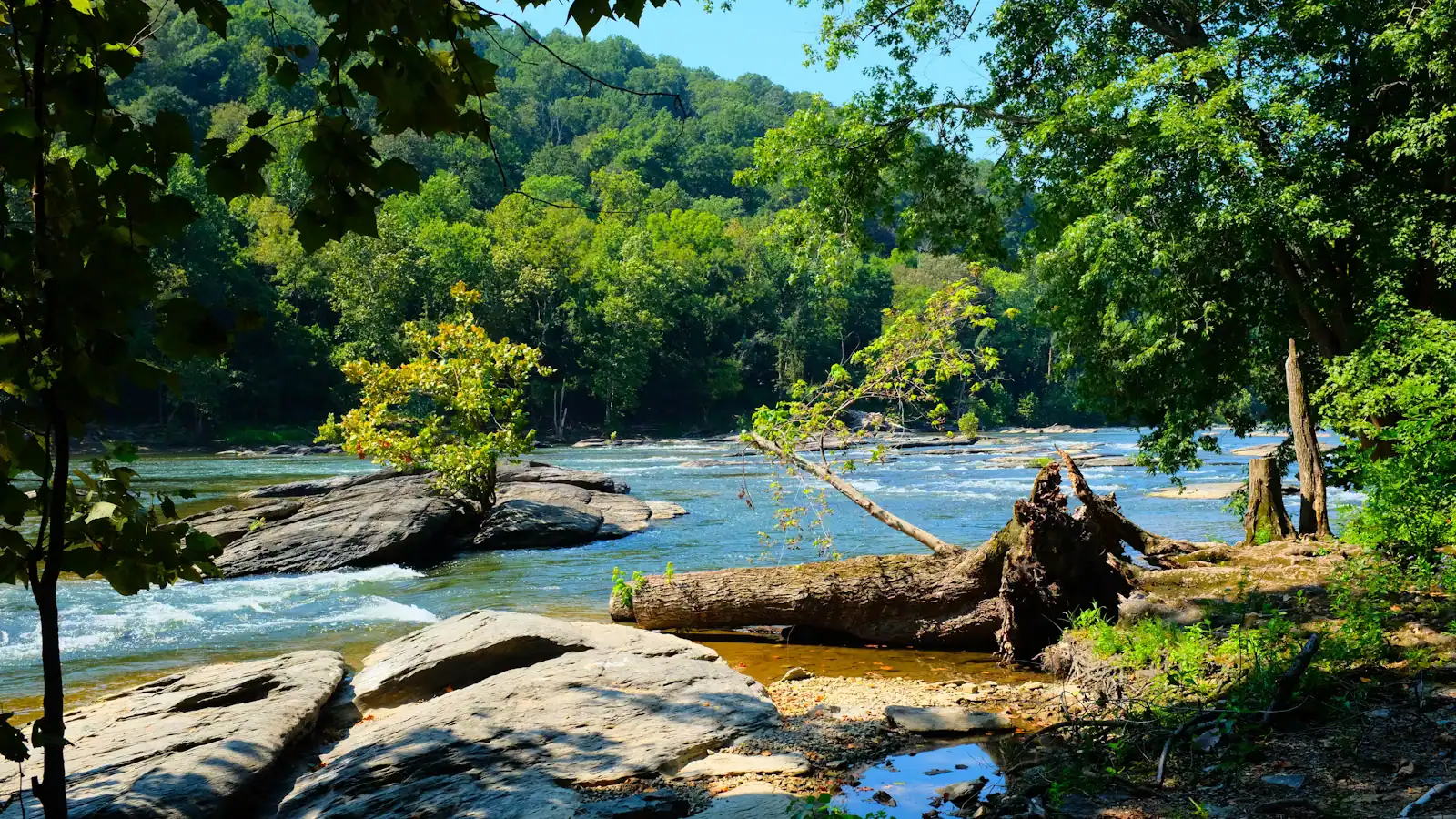
The lower Shenandoah below Millville runs over a sequence of rock ledges lying across the river rather than along it. Each ledge makes a drop; the drops come one after another; hence the Staircase.
Geologically these are the upturned edges of hard beds tilted during the building of the Appalachians, and they are the same structure you can see in the cliff faces from Jefferson Rock. The river cuts across the grain of the rock rather than with it, which is why it steps down instead of gliding.
Bull Falls is the largest single drop and the one the photographs are taken at. At high spring flows it is a substantial and genuinely Class III feature. At low summer flows it is a shallow rocky chute that requires a line rather than nerve.
Below the ledges the river flattens and runs down to the confluence past the Virginius Island ruins, which is the calm stretch every trip finishes on and the reason a rafting trip here ends with a history lesson whether you wanted one or not.
The whole commercial run is short by whitewater standards. That is part of the appeal: a half-day trip from a town you can walk around afterwards, rather than a full-day expedition in a gorge two hours from anywhere.
March to mid-May. Highest and coldest water. Snowmelt off the Blue Ridge and spring rain. This is when the Staircase is at its most serious and when whitewater trips are worth booking. It is also when trips get cancelled or rescheduled on short notice, and wetsuits are not optional.
Late May to June. The best combination for most visitors. Water still lively, air warm, wetsuit season ending. Book ahead — this overlaps with the thru-hiker season and with the best weather of the year.
July and August. Tubing flow. Warm, low, slow, shallow. Excellent with children and a genuinely pleasant way to spend a hot afternoon in a bowl that holds heat. Afternoon thunderstorms come up fast over the Blue Ridge and pull outfitters off the water at short notice.
September and October. The quiet half of the good weather. Water still warm enough, humidity broken, colour coming onto the ridges. Underrated and much less crowded than summer.
November to February. Commercial operations largely stop. The river is cold and the outfitters are not running.
We do not publish flow thresholds, departure times or prices. Ring the outfitter, and if you are travelling for a specific trip, ring them again the day before.
Guided raft. A crew of six or eight with a guide in the stern. The right choice for spring water, for anyone who wants the Staircase run properly, and for groups with mixed ability, because the guide does the thinking. This is where most of the bookable inventory sits.
Tube. A single inflated ring, a shuttle, and a couple of hours of drifting. Summer only, when the river is low and warm. Cheap, popular with families and teenagers, and completely dependent on flow — an outfitter will pull tubing before they pull rafting.
Funyak or inflatable kayak. One or two people, your own boat, running the same water under a guide's eye. Considerably more involving than a raft and considerably more forgiving than a hard kayak. A good middle option for people who want to be responsible for their own line.
Hard-shell kayak instruction. Local outfitters teach on this water because the Staircase gives you real features in a short, retrievable stretch with a road nearby.
Fishing float. The quieter commercial option, upstream of the ledges, for smallmouth bass. Licence rules differ between West Virginia, Virginia and Maryland, and you can be near more than one state line here, so check whose water you are on.
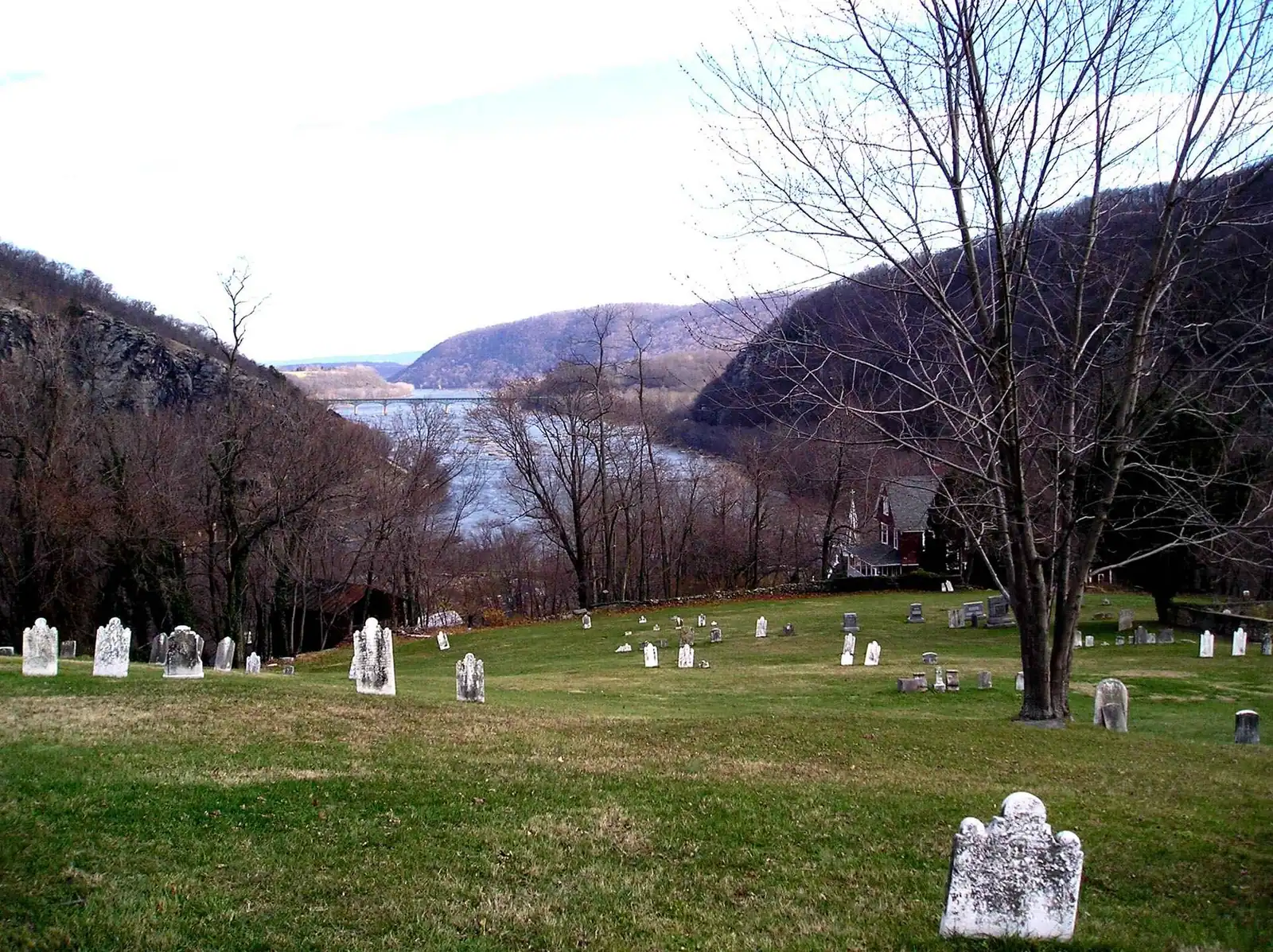
Before it was a leisure asset this was industrial plant, and the evidence is on the bank you float past at the end of every trip.
In 1806 and 1807 the Patowmack Company cut the Shenandoah Canal along the edge of the river to bypass the ledges and to deliver water power. The cut separated a strip of ground from the bank and created Virginius Island, twelve acres of manufactured real estate that became one of the more concentrated industrial sites in the region: cotton and flour mills, sawmills, a foundry, a tannery and a rifle works, with rail access from the late 1830s. Around 180 people lived on it at its peak in about 1850.
The Civil War took the rifle factory and much of the rest. Steam power then removed the advantage of sitting on a millrace. And the floods finished it: the river emptied the island permanently in 1936, and a further flood in 1996 closed it to visitors until 2003.
What is left is stabilised ruin in the trees along the Shenandoah bank — foundations, walls, the line of the headrace — reachable on a level walk from the lower town and almost always empty.
So the river you are tubing down in July is the same river that made this town, wrecked it, and made it again as a park.
Guided trips on this river are well run and the record is good. Unguided swimming is a different matter.
Do not swim at the confluence. Two substantial rivers meeting, ledges and nineteenth-century ironwork on the bed, and current far stronger than the surface suggests. There is no lifeguard, no designated swimming area and no easy exit.
Spring water is cold. Snowmelt water in April will take your breath in seconds regardless of the air temperature. If you are on the river before mid-May, wear what the outfitter gives you.
Rock ledges do not move. The Staircase is shallow at summer flows and the ledges are hard. Footwear that stays on your feet matters, and standing up in moving water is how people get feet trapped.
Thunderstorms build fast over the Blue Ridge on summer afternoons. If an outfitter cancels, they are not being cautious for the sake of it.
Check flow before you drive for this. A dry August can leave the run too low and a wet week can put it out of commercial range. Outfitters know by the morning; a website booked three weeks ago does not.
Operators run these trips past The Shenandoah, or stop there as part of a longer route. We list what the booking data supports — not everything that mentions the name.
A booking made through these earns us a commission from Viator. The price is the same, and the commission had no bearing on what is recommended.

Curated Catalog
With over 100 miles of trails ranging from beginner to expert, incredible guides, and top of the line ATV's, riders of all skill levels…
3–4 hours
Prices checked

Low Supplier Cancellation Rate
The New River Gorge is the second oldest river in the world. Coursing through a 1000' deep canyon that is lined with soaring sandstone…
6 hours
Prices checked

Weather Dependent - Moderate
We are one of the very few paddle boarding experiences in the New River Gorge. Explore the waterways of the New River Gorge area on…
2 hours
Prices checked

Obstacle Courses
TimberTrek Adventure Park invites adventurers of all ages to conquer a thrilling treetop challenge amidst four acres of lush forest. Begin…
3 hours
Prices checked

Curated Catalog
Real deal guided whitewater rafting through the spectacular New River Gorge National Park. Another notch on your bucket list - or become a…
6 hours
Prices checked

Top Product
Enjoy fantastic family-friendly rafting in America's newest national park! Enjoy a gentle float with: - National Park scenery and beauty…
5 hours
Prices checked

Extreme Sports
Bring the kids for an awesome family experience! Our Side by Side's seat up to 4 guests and allow those as young as 8 to take part in a…
3 hours
Prices checked
Straight-line distances, so allow more on the road — the island is long and has one main parkway.

Historic site
A vanished factory town on the Shenandoah: mill walls, a canal race and 180 residents, all of it taken by flood.
0.5–1.5 hoursIncluded with park entrance; no separate charge for the island150 ft away

Viewpoint
Ninety seconds from the shuttle stop, level the whole way, and the only spot where the town's geography explains itself.
10–30 minutesFree; covered by the park entrance fee already charged on your vehicle0.3 mi away

Neighbourhood
Two streets and a flight of stone steps, all of it inside a national park, with the high-water marks still on the walls.
2–5 hoursPark entrance fee applies; National Park Service exhibit buildings are then free to enter0.3 mi away

Trail
The Virginia ridge across the Shenandoah: more climbing than Maryland Heights, fewer views, and almost nobody on it.
4–5.5 hoursFree to walk; the park entrance fee applies to your vehicle at the visitor centre0.6 mi away
Where this place fits into a day, and the pages that plan one.

Guide hub
Two hundred and sixty-nine people lived here at the 2020 census. That number is the key to the whole day. Harpers Ferry is not a town with a…

Plan your trip
Forget the temperature chart for a moment. Two variables decide what kind of day you get in Harpers Ferry, and neither of them is the thermometer…

Things to do
The rivers are the reason there is a town here, and they are also the only thing in Harpers Ferry you can really book. Almost everything else on…

Who it suits
Children do well here, and the reason is not the history. It is that a national park has been laid over a town small enough to walk across in…

Guide hub
Most destination sites pad this page. We are not going to, because the tour market in Harpers Ferry is small and pretending otherwise would waste…

Guide
The colour reaches the ridge tops before it reaches the streets, the crowd arrives at eleven, and on the first weekend of November the last bus back moves ninety minutes earlier overnight.
9 min readEmmett Coyle

Guide
Cobbles, stone steps and a thousand-foot ridge on three sides. The flat walking is across a footbridge reached by stairs. Here is which parts of this actually work with children.
8 min readPrudence Ashby

Guide
The town sits in a bowl with high ground on three sides. You are either on a level towpath or climbing a thousand feet, and there is very little in between. Choose accordingly.
9 min readEmmett Coyle
The commercial run below Millville is Class I to III, with Bull Falls as the hardest single drop. At spring flows that is genuine whitewater with waves that will fill a raft, and a wetsuit is not optional because the water is snowmelt. By July the same stretch has usually dropped into a warm, bouncy float that families with children handle easily. The guide, not the calendar, decides what the trip is on any given morning.
Usually from late June through August, once spring flows have dropped and the water has warmed up. Tubing is the most flow-sensitive thing outfitters sell — it needs the river low and slow — so it is the first trip they pull in a wet summer and the first to stop if a thunderstorm puts the level up. Afternoon storms build quickly over the Blue Ridge. Ring the outfitter the day before rather than assuming a booking made weeks earlier will run.
Not at the confluence, and not anywhere in the park as a casual swim. There is no lifeguarded or designated swimming area. Where the two rivers meet, the current is far stronger than the flat surface suggests, the bed carries rock ledges and old industrial ironwork, and there is no easy exit. If you want to be in this water, go with an outfitter on the stretch they run, where somebody is watching and the level has been checked that morning.
North-east, down its valley for around 150 miles before joining the Potomac at Harpers Ferry — which makes it one of the minority of American rivers flowing broadly northward. That is also why the gap here exists: the combined river cuts east straight through the Blue Ridge rather than going around it, because the water is older than the ridge in its present form and kept cutting down as the rock rose.
Less than most destinations, and what there is is nearly all on this river. Guided rafting, tubing, funyaks, kayak instruction and float trips make up the bulk of the bookable market here, with a handful of guided history and ghost walks in the lower town. The national park itself, the trails, the viewpoints and the museums are covered by the entrance fee and need no booking at all, which is why most pages on this site carry no tour listings.