Autumn is the busiest season here and the best one, and it is almost entirely a question of arithmetic: how high you are standing, what hour you arrived, and whether the clocks have gone back yet.
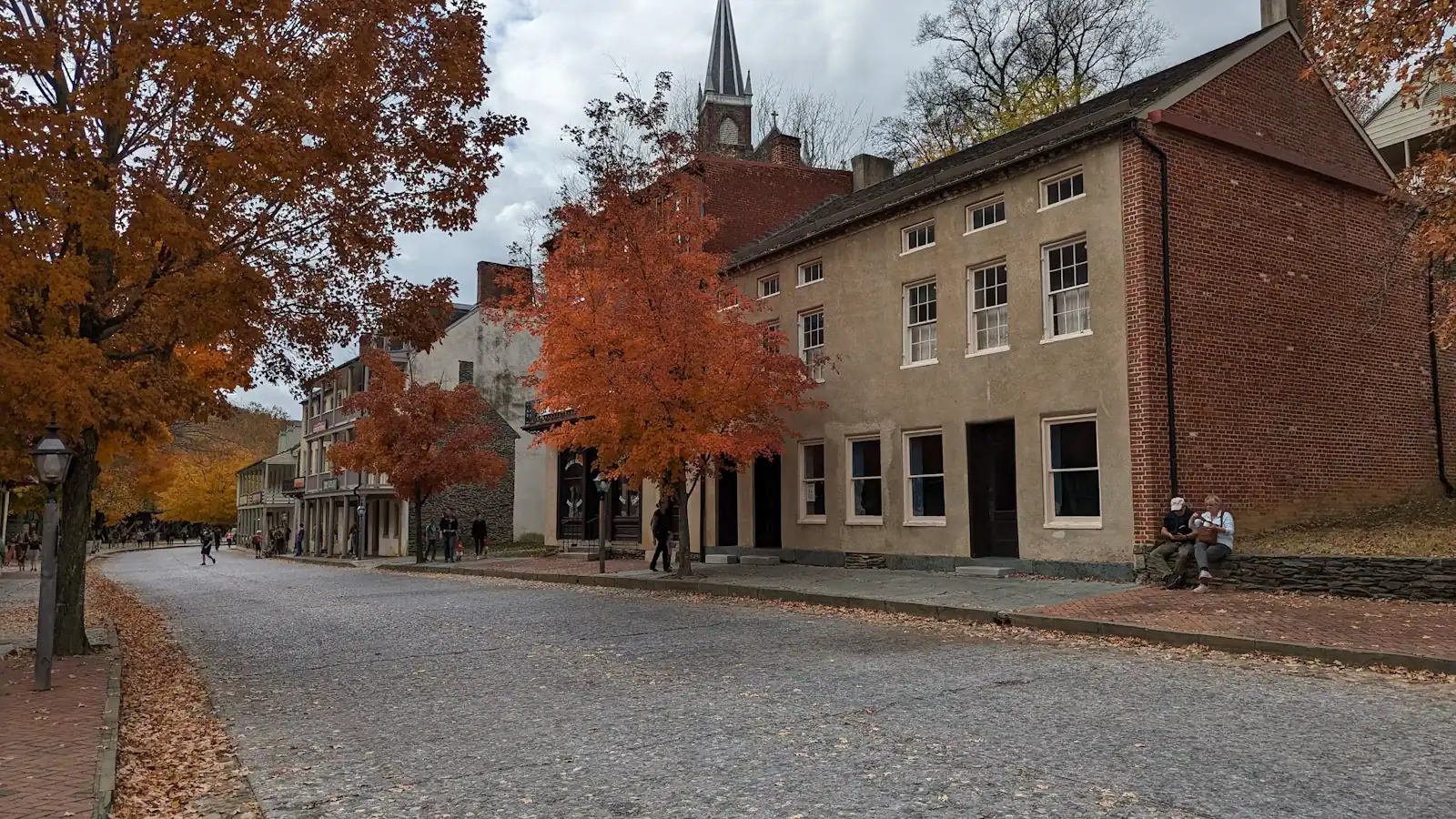
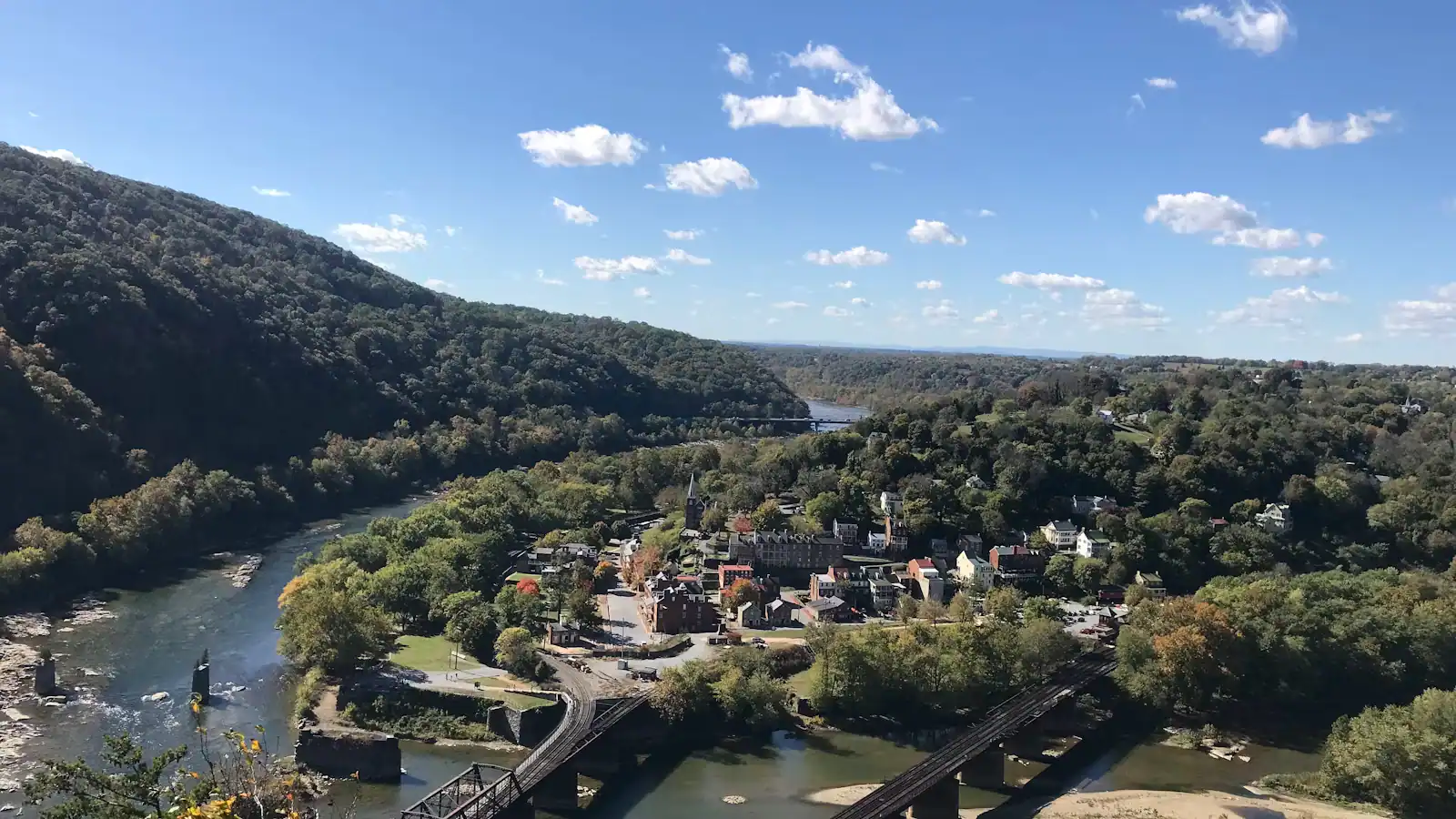
The town sits at about 509 feet in a bowl between two rivers. The ridges around it stand a thousand feet and more above that. Colour moves downhill, so the tops of Maryland Heights and Loudoun Heights turn while the streets are still green, and the last leaves in the lower town hang on well after the heights are bare. That gap is usually a week to ten days and it is the single most useful thing to know about planning an October visit: if you are early, go up; if you are late, stay down.
When the ridges turn
The honest answer is a window rather than a date. In a typical year the high ground colours through the middle of October and the lower town follows in the last week of the month into early November. In a dry summer it comes earlier and duller. After a warm September it can run a fortnight late. Anyone publishing a peak date in advance is guessing, and the West Virginia and Maryland foliage reports issued weekly through the season are worth more than any guide written in March.
| Window | Usually | Best used for |
|---|---|---|
| Late September | green, first turn on the highest ground | empty trails, warm river, no crowd at all |
| First week of October | ridge tops beginning | Maryland Heights and Loudoun Heights |
| Second and third weeks | the heights at their best, town still green | the classic overlook photograph |
| Last week of October | town and lower slopes turning, ridges past best | the streets, Jefferson Rock, the towpath |
| First half of November | lower town and riverbank holding on | quiet weekdays, low light, bare views |
The compensation for arriving after the leaves have gone is real: once the canopy is off, the views from the heights open up in every direction, and you can see the shape of the ground that made this place a fortress and a trap.
The crowd, stated plainly
October weekends are the busiest days of the Harpers Ferry year. A town of 269 people receives several thousand visitors, all of whom have to pass through one parking lot and one shuttle bus service.
The pressure is concentrated in a single window: roughly 10.30 a.m. to 2 p.m. on Saturday and Sunday. Outside it the place is manageable. Inside it you queue on the approach road, queue at the entrance station and queue for a bus.
- Arrive before 9.30 a.m. and the first two hours are yours. The lots open thirty minutes before sunrise, so a walker can be on Bolivar Heights or the towpath before the first shuttle runs at nine.
- Arrive after 3 p.m. and you trade the exhibit buildings, which close at five, for the best light of the day on the rivers.
- Come on a weekday. An October Tuesday is a different town from an October Saturday, and the colour does not know what day it is.
Two dates to put in the diary carefully. In 2026 the park waives entrance fees on Tuesday 27 October and Wednesday 11 November. A fee-free Tuesday in the last week of October is an unusually good deal and will also be the busiest weekday of the autumn. Note too that from 2026 the waiver applies to US citizens and residents only.
The clock change, which nobody plans for
This is the autumn fact that catches out more visitors than any other.
Daylight saving time in 2026 ends on 1 November. The shuttle timetable follows the clock rather than the calendar, so the last bus back up from the lower town to the visitor centre goes from 7 p.m. to 5.30 p.m. overnight. Ninety minutes, gone, on the weekend when the lower town is at its best and people most want to linger.
Plan the first weekend of November backwards from 5.30 p.m., not from sunset. The trails themselves stay open until thirty minutes after sunset, which creates exactly the trap you would expect: legally you can still be walking, and the bus that takes you back to your car has gone. The walk up the road to Cavalier Heights in the dark is long, steep and on a shoulder that was not built for pedestrians.
Where the height is worth the effort
Maryland Heights
The second or third week of October is what the season is for, and it is a serious walk: 4.5 to 6.5 miles, up to 1,788 feet of climb, three to four hours, no water anywhere on it. Start by nine. The overlook at midday on an October Saturday has an informal queue for the front of the ledge.
Loudoun Heights gives a comparable view of the same colour with a fraction of the company, and the heavier canopy that makes it less panoramic in summer makes it better in leaf.
Bolivar Heights, and the flat options
Bolivar Heights is where to go if the group cannot climb. Trailhead parking at the end of Whitman Avenue puts you on an open ridge looking west up the Shenandoah Valley, which is where the weather and the light come from. Under an hour of easy walking.
Jefferson Rock, fifteen to twenty minutes up the 1810 stone steps, looks along the Shenandoah rather than down on the confluence. Late October, when the lower slopes have turned, is its moment.
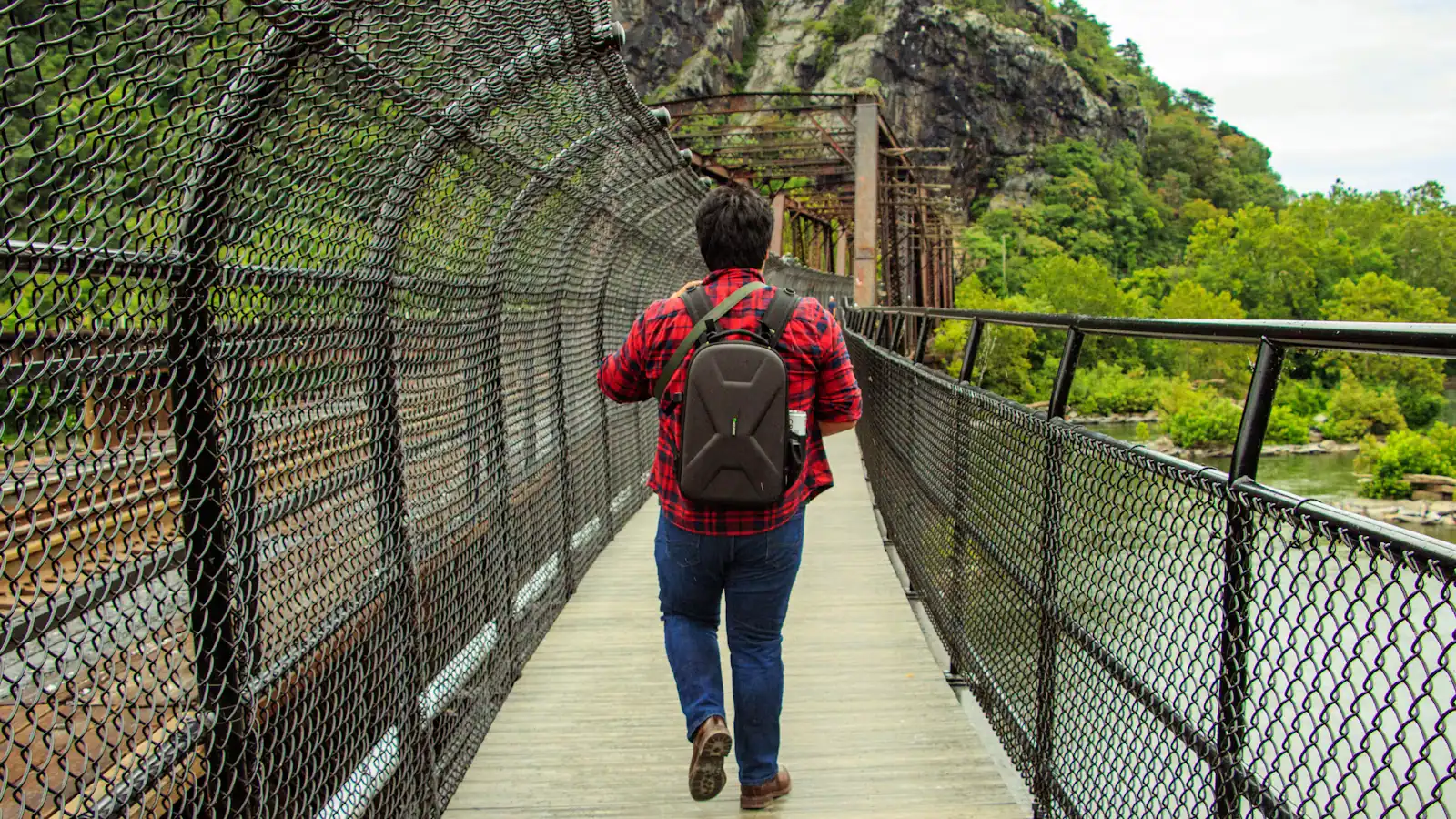
The towpath is the underrated one. Flat, on the Maryland bank, with the colour on both sides of the water and the river carrying leaves past you. It is also the only option here that works with a pushchair or for anyone who cannot manage steps, with the caveat that the footbridge to reach it has stairs.
What else October brings
The river season is winding down. Outfitters on the Shenandoah generally run into October and the water is at its clearest and coldest then, but trips thin out and a cold, bright autumn day on class II water is a different proposition from July. Check directly rather than assuming a booking page reflects this week.
Ticks do not stop in autumn in this part of West Virginia. Long trousers on trail, and check afterwards.
And the anniversaries land in this season: the raid began on 16 October 1859, and the September 1862 siege ended on Bolivar Heights on the fifteenth. The park often marks them with programming, which is worth asking about at the visitor centre desk rather than hunting for online.
The best October weekend, built properly
Saturday. In the lot at 8.15 a.m., before the entrance station has a queue. Walk Bolivar Heights while the light is low and the valley is holding mist — you can drive to that trailhead, so it costs you nothing in shuttle time. Down to the lower town on a mid-morning bus, exhibit buildings until lunch, eat at noon rather than one. Afternoon on the towpath. Out before the 4 p.m. wave of people leaving.
Sunday. Maryland Heights, on the trail by nine. Back down by one, which puts the descent ahead of the crowd going up. Lunch in Bolivar, where the kitchens are and where the visitors are not. Jefferson Rock and the stone steps late in the afternoon, when the low sun is along the Shenandoah rather than above it.
One vehicle pass covers both days and a third — three consecutive days for $20 at the time of writing — which is the argument for a weekend rather than a day.
What autumn weather actually does here
The gorge runs several degrees cooler than the plateau you parked on and holds damp long after the ridges have dried. A bright October morning in the lower town can be genuinely cold in the shade at nine and warm in the sun by eleven. Layers, not a coat.
Wet leaves are the hazard nobody mentions. The 1810 stone steps are worn concave and slick under leaf litter, the cobbles in the lower town are worse, and the smooth shale at the Maryland Heights overlook is not somewhere to find out. The first hard frost, usually in the second half of the month, makes shaded upper trail sections icy while the town is perfectly clear.
Nights draw in fast. By the last week of October the light is going by six, and after the clocks change on 1 November it is effectively dark before the trails officially close. Carry a head torch on any climb after the first week of the month, however mild the afternoon looks.
Last updated
Opening hours, ordinances and prices move with the season. We re-check this guide rather than rewrite it, and the date above is the last time someone did. How we research and correct.